Medically reviewed by Diana Medina, PA-C, board-certified Physician Associate · Last reviewed August 4, 2026
Key takeaways
NAD+ (nicotinamide adenine dinucleotide) is a coenzyme that helps move electrons for energy production and serves as a substrate for sirtuins and DNA-repair enzymes called PARPs.
The popular “NAD+ drops about 50% with age” claim traces to worms and aged mice; a 2026 Nature Metabolism study found whole-blood NAD+ essentially stable across age in humans.
Injectable and IV NAD+ are not FDA-approved, are compounded, prescription-only, and have only small, uncontrolled human safety data, not efficacy-grade evidence.
In 2025 the FDA designated a Class I recall, its most serious, for NAD+ injections with elevated endotoxin, underscoring why compounding quality matters.
What is NAD+? NAD+ stands for nicotinamide adenine dinucleotide, a coenzyme found in every cell of your body. Its best-known role is helping shuttle electrons during metabolism, which underpins how cells make ATP, their usable energy currency. People searching for NAD benefits often also ask whether NAD declines with age, partly because a wave of supplements and IV clinics built marketing around that idea. The honest answer in 2026 is more nuanced than the headlines: NAD+ is genuinely important biochemistry, but the human data on age-related decline and on injectable NAD+ is thinner and more cautious than the hype suggests.
What does NAD+ actually do in the body?
NAD+ is a dinucleotide redox coenzyme that exists in two forms: oxidized (NAD+) and reduced (NADH). Electron transfer is its central job, and that role underpins ATP generation, according to a biochemistry reference on nicotinamide adenine dinucleotide. In plain terms, NAD+ helps your cells convert food into energy.
Beyond redox chemistry, NAD+ is also consumed as a substrate by several enzyme families: sirtuins, PARPs (poly-ADP-ribose polymerases, involved in DNA repair), and CD38/CD157. These enzymes use NAD+ in protein modification, DNA repair, and transcription. A peer-reviewed review describes how PARPs use NAD+ for DNA-damage repair through poly-ADP-ribosylation, and notes that acute DNA damage can deplete NAD+, while sirtuins cleave NAD+ to deacetylate proteins. That mechanistic picture is largely built on cell and animal data, an important caveat when you see NAD+ marketed for “anti-aging.”
Human evidence on NAD+ and aging is still being written; 2026 data complicates the simple decline story.
Does NAD+ really decline with age?
This is the question the marketing rarely answers carefully. The claim that NAD+ falls steeply with age traces back to non-human models. The same review reports an approximately two-fold decline in old worms (C. elegans) and in aged-mouse tissues such as liver and skeletal muscle. Critically, no comparable human whole-blood age-decline was demonstrated in that work; the findings came from C. elegans and aged mice, not human blood.
More recent human data pushes back on the simple decline story. A 2026 study in Nature Metabolism measured whole-blood NAD+ in more than 300 people across seven cohorts (young and older adults, athletes, and frail elderly) using UHPLC-HRMS. It found whole-blood NAD+ was stable with age and lifestyle, and concluded it is not a useful aging biomarker. The same study did find that nicotinamide riboside, an NAD+ precursor supplement, raised blood NAD+, so the molecule is responsive to certain inputs even if it does not drift with age.
A companion 2026 Nature Metabolism paper goes further, arguing that whole-blood NAD+ cannot track aging because systemic NAD+ appears to be held in a narrow, possibly buffered range. Importantly, that does not prove tissues like aging muscle are unchanged; blood may simply not reflect what happens inside specific organs. So “NAD+ declines with age” is best treated as unproven in human blood rather than confirmed.
Claim
What the evidence shows
Population / model
NAD+ drops ~2-fold with age
Observed
Old worms; aged-mouse liver and skeletal muscle
Whole-blood NAD+ declines with age in humans
Not supported; appeared stable
Humans, 300+ across 7 cohorts (2026)
Blood NAD+ is a useful aging biomarker
Concluded “not useful”
Humans, cross-sectional (2026)
NR supplement raises blood NAD+
Observed
Humans, NR arm of 2026 study
What are the claimed NAD+ benefits, and how strong is the evidence?
Marketing for NAD+ injections and IV drips often promises more energy, sharper focus, and slower aging. Mechanistically, NAD+’s roles in metabolism, sirtuin signaling, and DNA repair make those ideas plausible to discuss. But plausibility is not proof. For injectable and IV NAD+ specifically, the human evidence is not efficacy-grade.
The clearest example is a 2026 retrospective pilot in Frontiers in Aging comparing IV NAD+ with intravenous (IV) nicotinamide riboside (NR) in just 14 people. It was a tolerability and safety look only, with variable outcomes and no placebo group. A study of that size and design cannot establish that NAD+ injections “work” for energy, cognition, or aging. If you are weighing delivery routes, our overview of NAD IV therapy versus injections walks through the practical differences, and our piece on NAD side effects covers what people report.
Some clinics bundle NAD+ with other compounds such as glutathione. As with NAD+, treat each component on its own evidence rather than assuming a combined drip multiplies the benefits.
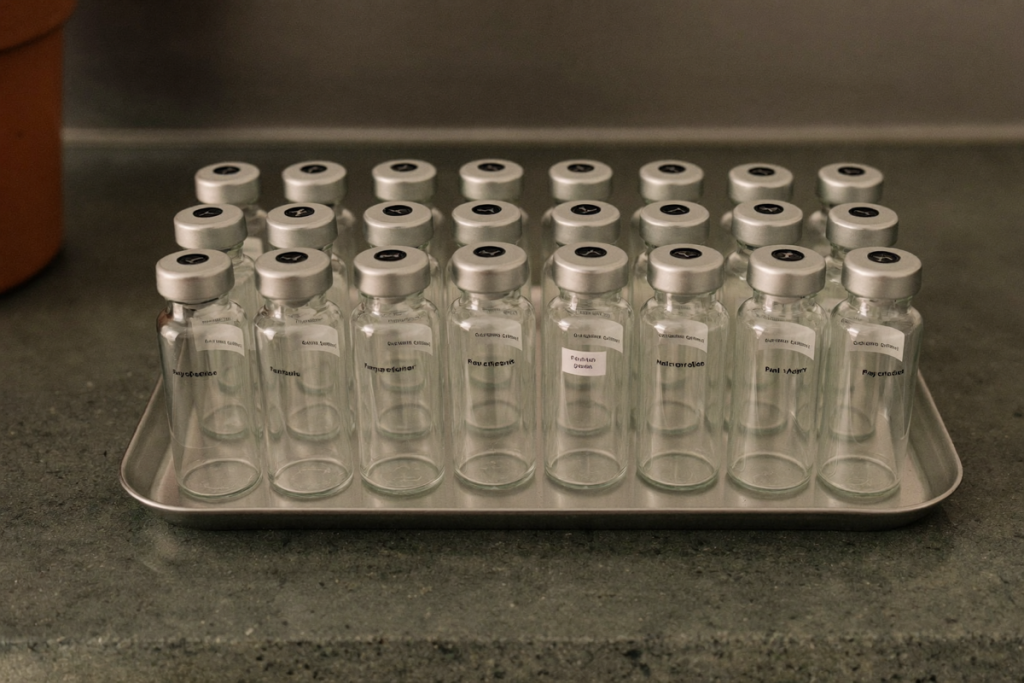
Compounded NAD+ injectables are not FDA-approved, and quality issues have led to recalls.
Is injectable or IV NAD+ FDA-approved and safe?
Injectable and IV NAD+ are not FDA-approved. They are compounded preparations (made under 503A or 503B pathways) available only with a prescription. NAD is not on the FDA’s list of bulk drug substances approved for use in 503A compounding, so it remains unapproved for that use; you can see how some compounders market these products in a commercial reference on NAD injections. There is no FDA-approved NAD+ injection dose. The FDA has not evaluated compounded NAD+ for safety, quality, or efficacy.
Quality is not a hypothetical concern. The FDA has reminded compounders that food-grade NAD+ used to make IV products risks microbe and endotoxin contamination, and reported adverse events including chills, shaking, vomiting, and fatigue. In 2025, NAD+ injectables were recalled for elevated endotoxin (in 100 and 200 mg/mL vials), and the FDA designated one such recall Class I, its most serious classification, in October 2025.
On the regulatory side, the FDA’s Pharmacy Compounding Advisory Committee (PCAC) recommended in 2017 against adding NAD to the 503A bulks list, citing its instability and inadequate clinical evidence; NAD is not an FDA-approved drug substance for this use. None of this means NAD+ is inherently unsafe at the molecule level; it means the injectable products carry real quality and evidence questions that a licensed provider should weigh with you.
How does NAD+ compare to a precursor like nicotinamide riboside?
One nuance worth flagging: the 2026 Nature Metabolism cohort study found that nicotinamide riboside (NR), an oral NAD+ precursor, raised whole-blood NAD+, whereas blood NAD+ did not vary with age. That tells us blood NAD+ can be moved upward by certain precursors. It does not, by itself, tell us that raising blood NAD+ produces the clinical benefits people hope for. Raising a lab value and improving how you feel or age are separate claims, and only the first has solid human support here.
If your underlying goal is energy, recovery, or healthy aging, it is worth being specific about the outcome you care about and discussing realistic, evidence-based options with a clinician. You can read more in our deeper explainer on NAD injections. That specificity matters because the delivery routes are not interchangeable: if the outcome you have in mind is how your skin looks rather than a whole-body effect, a topical NAD+ face cream acts on the skin directly through nicotinamide, a NAD+ precursor with a far better-studied cosmetic record than injected NAD+ has for skin.
Frequently asked questions
What is NAD+ in simple terms?
NAD+ (nicotinamide adenine dinucleotide) is a coenzyme in every cell. Its main job is transferring electrons during metabolism, which supports ATP (energy) production. It also serves as a substrate for sirtuins and DNA-repair enzymes (PARPs).
Does NAD+ decline with age?
An about two-fold decline was seen in old worms and aged-mouse tissues like liver and skeletal muscle. But a 2026 Nature Metabolism study of 300+ people found whole-blood NAD+ was stable with age and not a useful aging biomarker. In human blood, the steep-decline claim is not supported.
Are NAD+ injections FDA-approved?
No. Injectable and IV NAD+ are not FDA-approved. They are compounded, prescription-only preparations, and the FDA has not evaluated them for safety, quality, or efficacy. There is no FDA-approved NAD+ injection dose.
Do NAD+ IV drips actually work?
The human evidence is not efficacy-grade. A 2026 retrospective pilot comparing IV NAD+ with IV NR included only 14 people and looked at tolerability and safety, with no placebo and variable outcomes. That cannot establish that the drips “work.” Individual results vary.
Have NAD+ injections been recalled?
Yes. In 2025, NAD+ injectables were recalled for elevated endotoxin (100 and 200 mg/mL vials), and the FDA designated one such recall Class I, its most serious class, in October 2025. The FDA has also warned about contamination risks from food-grade NAD+ used in IV products.
Can a supplement raise my NAD+ levels?
In the 2026 Nature Metabolism study, the oral precursor nicotinamide riboside raised whole-blood NAD+. However, raising a blood NAD+ level is not the same as proving a clinical benefit, which remains unestablished for these products. Discuss options with a licensed provider.
Considering NAD+? Start with a provider
If you want to understand whether compounded NAD+ fits your goals, you can complete an online assessment and speak with a licensed provider who will review your health history and answer your questions.
Compounded NAD+ is not FDA-approved and is available by prescription only; the FDA has not evaluated it for safety, quality, or efficacy. This is educational information, not medical advice. Individual results vary.
Imai S, Guarente L, et al. NAD+ and Sirtuins in Aging and Disease (review). PMC4112140. https://pmc.ncbi.nlm.nih.gov/articles/PMC4112140/
Nature Metabolism. Whole-blood NAD+ does not vary with age (2026). https://www.nature.com/articles/s42255-026-01537-5
Nature Metabolism. Whole-blood NAD+ does not reflect healthy ageing (2026). https://www.nature.com/articles/s42255-026-01540-w
Frontiers in Aging. IV NAD+ vs IV nicotinamide riboside pilot, n=14 (2026). https://www.frontiersin.org/journals/aging/articles/10.3389/fragi.2026.1652582/full
U.S. FDA. FDA reminds compounders to use ingredients suitable for sterile compounding. https://www.fda.gov/drugs/human-drug-compounding/fda-reminds-compounders-use-ingredients-suitable-sterile-compounding
AboutNAD. FDA classifies NAD injection recalls (Class I, 2025). https://www.aboutnad.com/blogs/blog/fda-classifies-nad-injection-recalls-understanding-the-safety-risks-and-what-you-need-to-know-about-endotoxins-and-quality
U.S. FDA Pharmacy Compounding Advisory Committee. NAD 503A bulk drug substance evaluation (2017). https://archive.hshsl.umaryland.edu/server/api/core/bitstreams/f15198bc-1261-48bc-a9b3-c1fcb0e42c5b/content
Which areas of your health are you looking to improve?
Select all that apply.
Just a few details so we can recommend the right next step.
We'll route you to the best fit and follow up with personalized guidance.
 Medically reviewed by Diana Medina, PA-C, board-certified Physician Associate · Last reviewed August 4, 2026