Medically reviewed by Diana Medina, PA-C, board-certified Physician Associate · Last reviewed June 14, 2026
Key takeaways
There is no FDA-approved NAD+ drug product, so there is no official or recommended NAD+ dosage. Injectable NAD+ is compounded, prescription-only, and has not been evaluated by the FDA for safety, quality, or efficacy.
Any IV, subcutaneous, or intramuscular NAD injection dosage you see is provider-determined and individualized, drawn from compounding-practice reports, not from regulatory labeling or rigorous trials.
Slow administration and upward titration are the main strategy for tolerability, because rapid infusion is tied to flushing, nausea, cramping, and chest tightness that typically ease when the rate is slowed.
Injectable NAD+ benefits remain anecdotal and unproven; a 2026 systematic review found no rigorous outcomes trials for IV or IM NAD+. Individual results vary.
There is no single, correct NAD+ dosage, and no official one exists. Because there is no FDA-approved NAD+ drug product for any clinical use, there is no recommended or standard NAD injection dosage for IV, subcutaneous, or intramuscular routes. Injectable NAD+ is a compounded, prescription-only preparation that the FDA has not evaluated for safety, quality, or efficacy. The ranges discussed online and in clinics are provider-determined and individualized, not derived from regulatory labeling. This guide explains what the human evidence actually shows, how providers think about dose and frequency, and why slow administration matters.
Is there an official NAD+ dosage?
No. NAD+ has not been approved by the FDA as a drug, so there is no approved label, no official dose, and no government-recognized dosing schedule. Compounded NAD+ injection is supplied by 503A compounding pharmacies and 503B outsourcing facilities, typically as a lyophilized sterile powder (commonly 500 mg per vial) that is reconstituted before use. The manufacturer states plainly that compounded products are “not FDA-approved and have not been evaluated by the FDA for safety or efficacy.”
The regulatory history reinforces this. FDA’s September 5, 2019 proposed rule listed NAD among 26 substances proposed not to be included on the 503A bulk drug substances list. In short: every number in this article describes what some providers report, not an established or recommended dose.
What does the human evidence say about IV NAD+?
The best-documented human pharmacokinetic dataset is a small 2019 pilot study. In Grant et al. (Frontiers in Aging Neuroscience), 11 healthy men aged 30 to 55 (8 received NAD+, 3 received saline) underwent a 6-hour continuous IV infusion at 3 micromol per minute, roughly 2 mg per minute, for about 750 mg total. Plasma NAD+ rose significantly, by about 398%, but only at the 6-hour endpoint. There was no detectable change in plasma NAD+ for roughly the first two hours, which the authors interpreted as rapid tissue uptake and metabolism.
Two cautions matter here. First, this is a tiny pilot focused on pharmacokinetics, not an efficacy trial; it does not show clinical benefit. Second, the slow rate and gradual rise are exactly why many providers favor slow infusions and upward titration rather than fast, high-dose delivery.
Any NAD injection dosage is individualized and provider-determined, drawn from compounding-practice reports rather than approved labeling.
How much NAD+ do providers typically use, and how often?
Because dosing is individualized, the figures below are practice reports, not standards. They are determined by a licensed provider based on the person, the route, and tolerability, and they vary widely. Frequency, total dose, and titration are all individualized.
Route
Range some providers report
How it is framed
IV infusion
~500–1500 mg per session over ~2–4 hours
Provider-determined; slow rate for tolerability; not an official dose
Subcutaneous (SubQ)
Often start ~20–50 mg, titrate toward ~100 mg, roughly 2–3x/week up to daily
Only two human injectable NAD+ figures are well traced to primary sources: the 2019 pharmacokinetic pilot (750 mg over 6 hours, +398% plasma at 6 hours, 11 men) and a 2026 tolerability study (500 mg per day for 4 days, 6 patients). The SubQ and IM ranges above are reported in compounding practice and are not derived from controlled trials, so they should never be read as established dosing. If you want a deeper look at the routes themselves, see our overview of NAD IV therapy vs injections and our discussion of NAD injections.
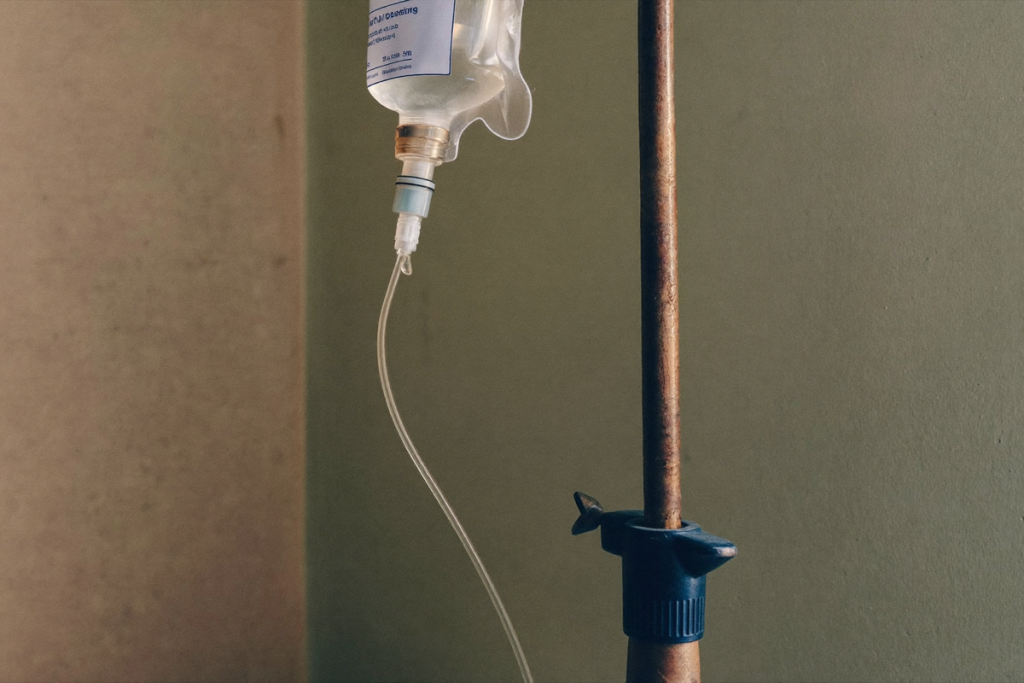
NAD+ is typically infused slowly; rapid delivery is tied to flushing, nausea, and chest tightness that ease when the rate is slowed.
Why is NAD+ given slowly, and what side effects drive titration?
Infusion-related side effects are the main reason NAD+ is administered slowly. A 2026 real-world retrospective study in Frontiers in Aging looked at 14 adults in a commercial clinic, 6 of whom received 500 mg NAD+ IV per day for 4 consecutive days (in 500 mL saline) versus 8 who received IV nicotinamide riboside. All 6 NAD+ patients reported moderate-to-severe symptoms during infusion, including abdominal cramping, diarrhea, nausea, vomiting, increased heart rate, throat pain, congestion, and chest pressure, which resolved when the infusion was complete.
Tellingly, NAD+ infusions took far longer than nicotinamide riboside infusions, a mean of 97 plus or minus 56 minutes versus 37 plus or minus 13 minutes, reflecting the need to slow the rate so patients could tolerate it. The practical takeaway, consistent with the slow-rate pharmacokinetic pilot above, is that symptoms like flushing, warmth, lightheadedness, headache, chest tightness, cramps, and transient heart-rate changes are tied to too-rapid delivery and are typically lessened by slowing or pausing the infusion and titrating the dose upward over time. For more on what people experience, see our notes on NAD side effects.
Does NAD+ really decline with age, and does dose “restore” it?
This is where dosing logic often gets oversold. The popular claim that blood NAD+ “declines about 50% with age” is not supported by recent whole-blood data. A 2026 study in Nature Metabolism examined 7 independent cohorts and more than 300 people and found that whole-blood NAD+ did not vary meaningfully with age, and did not shift with exercise, protein-rich diets, or multimodal lifestyle interventions.
An honest caveat belongs here: this finding concerns whole blood, and blood is a poor proxy for intracellular or tissue NAD+. The results refine, rather than refute, tissue-level NAD+ biology. Still, the upshot for dosing is important. There is no validated blood target to “correct,” so no dose can be justified as restoring a number that whole-blood data does not show changing predictably with age.
Is injectable NAD+ proven to work?
Not in the rigorous sense. A 2026 PRISMA-guided systematic review found essentially no rigorous outcomes randomized controlled trials showing that IV or IM NAD+ provides anti-aging or general wellness benefits; reported benefits remain anecdotal and speculative. Oral precursors such as nicotinamide riboside and NMN have more human data than injectable NAD+, though that evidence is still moderate at best.
Because evidence is thin, no provider can promise a result, a timeline, or a particular benefit from any NAD+ dose, and individual results vary. NAD+ is one of several longevity-adjacent options people explore; others discussed in compounded telehealth include sermorelin and glutathione, each with its own evidence base and regulatory status. If you are weighing options, an evaluation with a licensed provider is the appropriate next step.
How is NAD+ obtained safely?
NAD+ injection requires a valid prescription and qualified-provider supervision. The FDA has cautioned that food-grade NAD, as opposed to pharmaceutical-grade, should not be used for injectables because of contamination and adverse-event risk. That makes sourcing through a licensed provider and an accredited compounding pharmacy, with proper monitoring, the safest route. Self-injecting non-pharmaceutical-grade material is not advisable. Anyone considering NAD+ should review their full medical history, medications, and goals with a clinician who can individualize and monitor any plan.
Frequently asked questions
What is the recommended NAD+ dosage?
There is no recommended or official NAD+ dosage, because no NAD+ drug is FDA-approved. Injectable NAD+ is compounded and prescription-only, and the FDA has not evaluated it for safety, quality, or efficacy. Any dose is provider-determined and individualized.
How much NAD+ is used in an IV session?
Some providers report IV sessions of roughly 500 to 1500 mg over about 2 to 4 hours, but this is a practice report, not a standard. For reference, one 2019 human pharmacokinetic pilot infused about 750 mg over 6 hours in 11 healthy men. None of these are official doses, and your provider determines what is appropriate.
Why is NAD+ infused so slowly?
Rapid infusion is linked to side effects such as flushing, nausea, cramping, chest tightness, and a transient rise in heart rate. In a 2026 retrospective study, all 6 NAD+ patients had moderate-to-severe infusion symptoms, and infusions took about 97 minutes on average. Slowing the rate and titrating upward typically improves tolerability.
How often should NAD+ be given?
Frequency is individualized and provider-determined. Subcutaneous regimens are sometimes reported around 2 to 3 times weekly up to daily, and intramuscular around 1 to 3 times weekly, but these are compounding-practice reports, not established schedules. There is no trial-validated frequency.
Does NAD+ decline with age, so I need to dose to restore it?
A 2026 Nature Metabolism study of 7 cohorts and more than 300 people found whole-blood NAD+ did not vary meaningfully with age or with lifestyle interventions, which challenges the popular “declines 50% with age” claim. Blood is a poor proxy for tissue NAD+, so the finding refines rather than refutes tissue biology, but there is no validated blood target to “restore” with a dose.
Is injectable NAD+ proven to slow or reverse aging?
No. A 2026 systematic review found no rigorous outcomes trials demonstrating anti-aging or wellness benefits from IV or IM NAD+; benefits remain anecdotal. No provider can guarantee results, and individual results vary.
Considering NAD+? Start with a provider evaluation
If you are curious whether compounded NAD+ fits your goals, complete a confidential online assessment and discuss your history, options, and monitoring with a licensed provider.
Compounded NAD+ injection is not FDA-approved, is prescription-only, and has not been evaluated by the FDA for safety, quality, or efficacy. This is educational information, not medical advice. No outcome is promised; individual results vary, and any treatment is determined by a licensed provider.
Grant R, et al. A Pilot Study Investigating Changes in the Human Plasma and Urine NAD+ Metabolome During a 6 Hour Intravenous Infusion of NAD+. Frontiers in Aging Neuroscience (2019). https://pmc.ncbi.nlm.nih.gov/articles/PMC6751327/
Retrospective tolerability pilot: IV NAD+ vs IV nicotinamide riboside (NR). Frontiers in Aging (2026). https://pmc.ncbi.nlm.nih.gov/articles/PMC12907335/
Human whole-blood NAD+ levels do not vary with age or lifestyle interventions. Nature Metabolism (2026). https://www.nature.com/articles/s42255-026-01537-5
Companion News & Views: whole-blood NAD+ does not reflect healthy ageing. Nature Metabolism (2026). https://www.nature.com/articles/s42255-026-01540-w
PRISMA-guided systematic review of NAD+ supplementation for anti-aging and wellness. ScienceDirect (2026). https://www.sciencedirect.com/science/article/pii/S1568163726000498
FDA. Amendments to the List of Bulk Drug Substances That Can Be Used To Compound Drug Products (proposed rule). Federal Register (September 5, 2019). https://www.federalregister.gov/documents/2019/09/05/2019-18951/amendments-to-the-list-of-bulk-drug-substances-that-can-be-used-to-compound-drug-products-in
FDA. FDA Reminds Compounders To Use Ingredients Suitable for Sterile Compounding (food-grade NAD+ contamination and adverse-event warning). U.S. Food and Drug Administration. https://www.fda.gov/drugs/human-drug-compounding/fda-reminds-compounders-use-ingredients-suitable-sterile-compounding

 Medically reviewed by Diana Medina, PA-C, board-certified Physician Associate · Last reviewed June 14, 2026