NAD+ IV Therapy vs Injections: Which Is Right for You?
 Medically reviewed by Diana Medina, PA-C, board-certified Physician Associate · Last reviewed June 14, 2026
Key takeaways
- The biggest practical difference is logistics: a NAD+ IV infusion is typically run slowly over roughly 2-4 hours in a clinic, while a compounded NAD+ injection takes minutes and can often be self-administered at home.
- NAD+ is not FDA-approved for any route (IV, subcutaneous, intramuscular, or oral). The product used clinically is compounded and prescription-only, and the FDA has not evaluated it for safety, quality, or efficacy.
- Human evidence is very limited and there is no head-to-head clinical trial proving IV is superior to injections; “100% bioavailability” for IV is a theoretical concept, not a measured human figure.
- IV side effects are commonly described as rate-dependent (worse with faster infusion), which is why clinics infuse slowly; individual experiences vary and any use should be under licensed-provider oversight.
If you are weighing NAD+ IV therapy vs injections, the honest short answer is that the choice is driven mostly by convenience, tolerability, and cost rather than by proven superiority of one route. In an NAD infusion vs injection comparison, IV delivers NAD+ directly into the bloodstream over a long clinic session, while a subcutaneous (SubQ) or intramuscular (IM) injection is a quick shot, often given at home. Both forms used clinically are compounded, prescription-only, and not FDA-approved. The FDA does not verify the safety, quality, or effectiveness of compounded drugs before they are marketed.
Is NAD+ FDA-approved as an IV or an injection?
No. There is no FDA-approved drug label for IV or injectable NAD+, and NAD+ is not FDA-approved to diagnose, treat, cure, or prevent any disease, according to FDA guidance on compounding. Clinically used NAD+ is a compounded preparation made by 503A or 503B pharmacies. Because it is compounded, its sterility, potency, and purity are not FDA-verified, and the FDA warns that poor compounding can lead to contamination or products that lack the intended strength or quality.
The regulatory picture is also unfavorable, not neutral. NAD was nominated for the bulk drug substances list for IV, subcutaneous, and oral use, but the FDA’s Pharmacy Compounding Advisory Committee (PCAC) in 2017 recommended against adding NAD to the 503A bulks list, citing its susceptibility to degradation (light, moisture, temperature) and inadequate literature supporting its clinical use and safety. None of this means NAD+ cannot be prescribed by a licensed provider; it means you should not treat it as equivalent to an approved drug.
How does the body actually handle infused NAD+?
The mechanistic rationale for IV is straightforward: it bypasses the gut and first-pass liver metabolism, which is the theoretical basis for higher bioavailability than oral routes (described in an industry-funded preprint that is not peer-reviewed). But “100% bioavailability” is illustrative, not a measured human number, and no validated bioavailability percentage exists for IV, SubQ, or IM NAD+ in people.
The most direct human data come from a small pilot pharmacokinetic study in 11 healthy men (8 test, 3 control), ages 30-55, who received 750 mg of NAD+ infused IV over 6 hours at about 3 micromol/min. The authors reported no change in plasma NAD+ or its metabolites until after roughly 2 hours of infusion, suggesting infused NAD+ is rapidly taken up or metabolized rather than simply accumulating in the blood. By the end of the 6-hour infusion, plasma NAD+ had risen about 398% from baseline, and the urinary NAD+ excretion rate was about 538% higher than the rate measured at 30 minutes. These are percentage changes from a single 11-person study, and they describe the IV route only; they should never be applied to injection dosing.
NAD+ IV therapy vs injections: how do they compare?
The table below summarizes the practical differences. Dosing ranges are provider-determined and are not FDA-approved dosing.
| Factor | NAD+ IV infusion | NAD+ injection (SubQ / IM) |
|---|---|---|
| Where it’s done | In-clinic; supervised | Often self-administered at home after training |
| Time per session | Typically slow, ~2-4 hours (clinic sources) | Minutes |
| Representative dose | ~250-1,000+ mg per session (provider-set) | SubQ and IM doses are provider-determined, commonly in the tens-to-low-hundreds of mg per injection, often titrated upward to limit side effects; not FDA-approved dosing |
| Illustrative US cost | ~$250 to $1,000-$1,500+ per session | ~$40-$200 per injection (market estimates) |
| FDA status | Compounded; not FDA-approved | Compounded; not FDA-approved |
Cost figures are general US market ranges from secondary sources for context only, not Revive pricing. The clearest practical differentiator is convenience: injections are quick and often done at home, while IV is a long, supervised clinic visit.
Which route has more side effects?
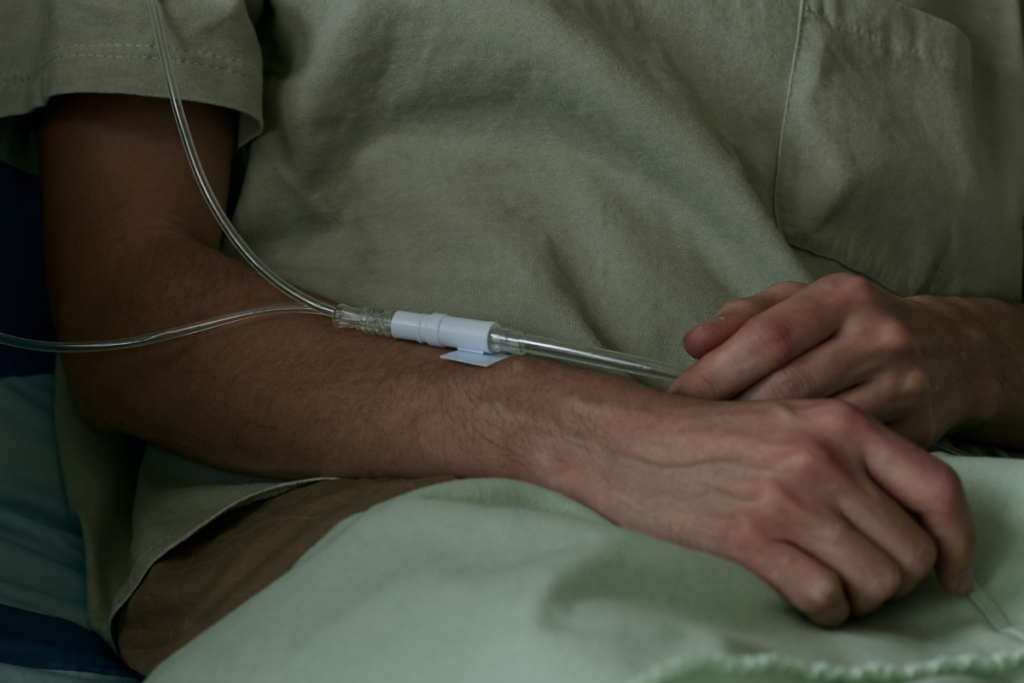
Tolerability is where IV draws the most attention, and the available data are small. In a retrospective chart review of 14 wellness-clinic clients (NAD+ IV n=6; nicotinamide riboside IV n=8) who received 500 mg IV daily for 4 days, all six NAD+ IV clients reported moderate-to-severe symptoms during infusion (abdominal cramping, diarrhea, nausea, vomiting, increased heart rate, throat pain, congestion, chest pressure) that ceased immediately when the infusion finished. This is a tiny, retrospective sample, not a controlled trial, but it is consistent with broader clinic reports.
Those reports describe NAD+ IV side effects as rate-dependent: flushing, nausea, chest tightness, lightheadedness, cramps, and headache tend to worsen with faster infusion and ease when the drip is slowed or paused. That is precisely why clinics run NAD+ slowly over several hours. (Worth noting: the detailed flushing mechanism via the GPR109A receptor is established for nicotinic acid, or niacin, in mice and human dermatology literature, not for NAD+ itself; rapid NAD+ infusion can generate niacin-pathway metabolites.) Injections deliver a smaller, slower-absorbing dose, but no head-to-head human trial has compared injection tolerability to IV. None of this makes any route “safe” or “well tolerated” as a matter of fact; side effects are commonly reported, usually transient, vary by individual, and warrant licensed-provider oversight.
Does IV actually work better than an injection?
There is no human randomized controlled trial establishing that IV NAD+ is superior to SubQ or IM injections, or vice versa. The evidence base is limited to small pilots and one ChromaDex-funded preprint that has not been peer-reviewed. That preprint reported that an NR (Niagen+) IV raised NAD+ by up to about 20% with roughly 75% less infusion time than standard NAD+ IV, but those figures compare a different molecule (nicotinamide riboside) to NAD+, not SubQ to IV, and should be read with the industry-funded, non-peer-reviewed caveat front and center.
Importantly, route-comparison evidence is still being generated. A recruiting clinical trial (NCT06919328) is comparing injectable NAD+ versus Niagen+ across IM, subcutaneous, and IV-push routes, with injection-site pain and discomfort (the McGill Pain Questionnaire and a subjective-discomfort assessment) as its primary outcomes. Until results like these are published, claims that one route is definitively “better” are ahead of the data.
How do I choose between NAD+ IV therapy and injections?
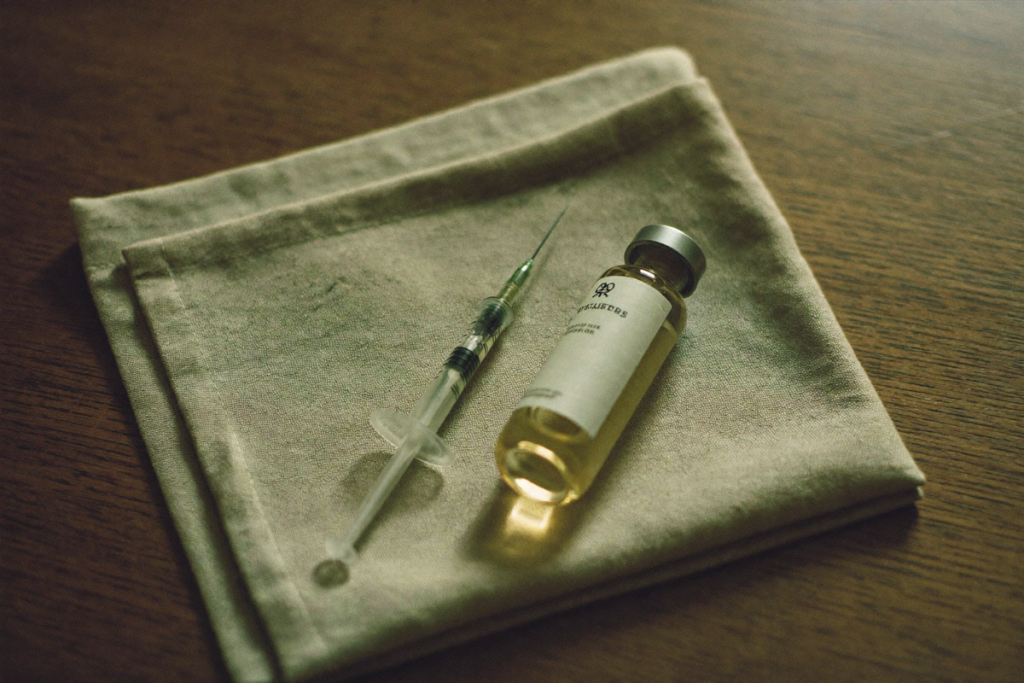
For most people the decision is practical. If you value a quick routine you can manage yourself, injections at home may fit better. If you prefer a clinical setting with monitoring, or your provider recommends a higher single dose, IV may make sense despite the time commitment and the rate-dependent side effects. Either way, the most important step is working with a licensed provider and a reputable, accredited compounding pharmacy. If you are also exploring related longevity options, you can read more about NAD+ injections specifically, or browse other compounded therapies like glutathione, and see how Revive’s process works before starting an evaluation.
Frequently asked questions
Is NAD+ IV therapy or injection FDA-approved?
No. Neither route is FDA-approved. NAD+ used clinically is compounded and prescription-only, and the FDA has not evaluated compounded NAD+ for safety, quality, or efficacy.
Does NAD+ IV have 100% bioavailability?
“100% bioavailability” is a theoretical idea based on IV delivering a drug directly into the bloodstream. It is not a measured human figure for NAD+, and a small human pilot found infused NAD+ was rapidly cleared from plasma rather than simply accumulating.
Why does a NAD+ IV take so long?
Side effects such as nausea, flushing, cramping, and chest tightness are commonly described as rate-dependent, so clinics infuse NAD+ slowly, often over roughly 2-4 hours, to reduce them. Individual experiences vary.
Can I do NAD+ injections at home?
Compounded NAD+ injections are often self-administered at home after training, which is their main convenience advantage over IV. They are still prescription-only and require a licensed provider’s oversight and a properly compounded product.
Is IV more effective than injections for NAD+?
There is no head-to-head human trial proving one route is superior. The route-comparison evidence is still being generated, including a recruiting trial comparing IM, SubQ, and IV-push injectable NAD+.
How much do NAD+ IV therapy and injections cost?
General US market estimates from secondary sources put NAD+ IV sessions around $250 to $1,000-$1,500+, and single injections around $40-$200. These are illustrative ranges, not Revive pricing, and vary widely by clinic and dose.
Considering NAD+?
If you want to understand whether NAD+ IV therapy or injections might fit your goals, start an online assessment and discuss your options and the limits of the evidence with a licensed provider.
Prescription only. Compounded; not FDA-approved. The FDA has not evaluated compounded NAD+ for safety, quality, or efficacy. Educational information, not medical advice. Individual results vary.
Sources
- U.S. Food & Drug Administration. Compounding and the FDA: Questions and Answers. https://www.fda.gov/drugs/human-drug-compounding/compounding-and-fda-questions-and-answers
- U.S. Food & Drug Administration. Human Drug Compounding: Consumer and Health Care Professional Information. https://www.fda.gov/drugs/human-drug-compounding/consumer-and-health-care-professional-information
- University of Maryland / FDA. Nicotinamide Adenine Dinucleotide (NAD) Bulk Substances Review; PCAC recommendation against 503A listing (2017). https://archive.hshsl.umaryland.edu/server/api/core/bitstreams/f15198bc-1261-48bc-a9b3-c1fcb0e42c5b/content
- Grant R, et al. A Pilot Study Investigating Changes in the Human Plasma and Urine NAD+ Metabolome During a 6-Hour Intravenous Infusion of NAD+ (n=11). PMC (2019). https://pmc.ncbi.nlm.nih.gov/articles/PMC6751327/
- Retrospective tolerability comparison of IV NAD+ vs nicotinamide riboside in a wellness clinic (n=14). PMC / Frontiers in Aging. https://pmc.ncbi.nlm.nih.gov/articles/PMC12907335/
- ChromaDex-funded randomized placebo-controlled pilot of Niagen+ (NR) IV and NAD+ IV in healthy adults (preprint, not peer-reviewed). medRxiv (2024). https://www.medrxiv.org/content/10.1101/2024.06.06.24308565v1
- ClinicalTrials.gov. Absorption and Tolerability of Injectable Niagen+ vs NAD+ (IM/SubQ/IV-push), NCT06919328. https://clinicaltrials.gov/study/NCT06919328
- Hanson J, et al. Nicotinic acid- and monomethyl fumarate-induced flushing involves GPR109A expressed by keratinocytes and COX-2-dependent prostanoid formation. Journal of Clinical Investigation (2010). https://www.jci.org/articles/view/42273
- Strut Health. NAD+ Injections: Subcutaneous vs Intramuscular Compared. https://www.struthealth.com/blog/nad-injections-subcutaneous-vs-intramuscular-compared
- Restore Hyper Wellness. NAD+ IV Therapy Side Effects. https://www.restore.com/blog/nad-iv-therapy-side-effects
- Vaccine Alliance. NAD+ Injections: Cost. https://www.vaccinealliance.org/nad-injections/cost/