NAD+ Benefits for Women: What to Know
 Medically reviewed by Diana Medina, PA-C, board-certified Physician Associate · Last reviewed August 4, 2026
Key Takeaways
- NAD+ (nicotinamide adenine dinucleotide) is a coenzyme involved in cellular energy metabolism and DNA repair in every cell, including in women. It is not a hormone and is not a treatment for menopause.
- The long-repeated claim that NAD+ falls with age is less settled than it sounds: a 2026 Nature Metabolism analysis across seven human cohorts found that whole-blood NAD+ levels did not clearly vary with age, so “restoring an age-related decline” should be read with caution.
- NMN, an oral NAD+ precursor, is a lawful dietary-supplement ingredient (the FDA confirmed this in September 2025). Injectable and IV NAD+ are compounded preparations that are not FDA-approved; the FDA has not evaluated them for safety, quality, or efficacy.
- The most-cited human study in women, a 2021 Science trial, tested oral NMN (not injectable NAD+) in 25 postmenopausal women with prediabetes and reported improved muscle insulin sensitivity, not weight loss, more energy, or symptom relief.
- Whether any NAD+ approach is appropriate for you is a decision for a licensed provider. Benefits, timelines, and costs vary by person, and this article is educational information, not medical advice.
For women researching NAD+, the honest short answer is this: NAD+ is a coenzyme your cells use to convert nutrients into energy and to support DNA repair, and the research on supplementing it, especially in women, is early and mixed rather than conclusive. NAD+ benefits for women are frequently described in marketing as more energy, better skin, sharper focus, and smoother menopause, but the human evidence behind those specific promises is thin, and the most-discussed precursor product (oral NMN) is regulated very differently from the injectable and IV NAD+ offered at wellness clinics. This guide separates what the science actually supports from what is still unproven, with particular attention to questions women ask.
What is NAD+ and what does it do in the body?
NAD+, short for nicotinamide adenine dinucleotide, is a coenzyme present in every living cell. It participates in hundreds of reactions, most centrally in the mitochondrial pathways that turn food into usable cellular energy (ATP), and it serves as a substrate for enzymes involved in DNA repair and cellular signaling. It is a metabolic helper molecule, not a hormone, not a vitamin you must eat directly, and not a drug with an approved indication for energy, anti-aging, or menopause.
The body makes NAD+ from several inputs, including the B3 vitamin family (niacin and nicotinamide) and precursors such as nicotinamide riboside (NR) and nicotinamide mononucleotide (NMN). This is why most consumer “NAD+ support” supplements are actually precursors rather than NAD+ itself.
Do NAD+ levels really decline with age in women?
This is the assumption underneath most NAD+ marketing, and it is more contested than it appears. Many earlier reports suggested NAD+ falls in tissues as we age. However, a 2026 analysis published in Nature Metabolism measured NAD+ across seven independent human cohorts using validated mass-spectrometry methods and found that whole-blood NAD+ levels did not clearly vary with age or with common lifestyle interventions, while still rising as expected after NR supplementation. The authors concluded that blood NAD+ may not be a reliable biomarker of aging.
An important nuance: blood is not the same as tissue. NAD+ is regulated differently across organs, and some tissue and animal research, including work on ovarian aging, has reported larger NAD+ changes than blood tests show. So the most accurate statement is not “NAD+ definitely declines with age in women,” but rather “NAD+ biology changes with age in ways that are still being mapped, and a blood NAD+ number is not a validated measure of how old your cells are.”
What does the research say about NAD+ benefits specifically for women?
The single most-cited human study in women is a 2021 randomized, placebo-controlled trial published in Science by Yoshino and colleagues. It enrolled 25 postmenopausal women with prediabetes who were overweight or obese, gave the treatment group 250 mg of oral NMN daily for about 10 weeks, and reported an increase in skeletal-muscle insulin sensitivity of roughly 25 percent versus placebo. Two things are essential to read accurately:
- This was oral NMN, a precursor, not injectable or IV NAD+.
- The measured benefit was a specific metabolic marker (muscle insulin sensitivity). The study did not show weight loss, increased subjective energy, improved mood, better skin, or relief of menopausal symptoms; in fact body weight and body composition did not change, and the finding has been debated by other researchers.
Beyond that trial, much of what is said about NAD+ “for women,” including claims tied to menopause, ovarian aging, fertility, and skin, rests largely on laboratory and animal studies. Animal research has reported steep drops in ovarian NAD+ during reproductive aging and improvements in egg quality with NAD+ precursors, but these are animal findings and have not been established as benefits in women. They are reasons for ongoing research, not proof of a result you can expect. Skin is worth separating out from that list, because it is the one goal where the route matters as much as the molecule: a topical formulation such as Revive’s NAD+ Face Cream delivers nicotinamide, the NAD+ precursor with the strongest dermatology evidence behind it, directly to the skin, which is a different product category from injectable or IV NAD+ rather than a substitute for it.
NMN supplements versus injectable and IV NAD+: what’s the difference?
For women comparing options, the regulatory distinction matters as much as the biology.
| Feature | Oral NMN / NR (precursor supplements) | Injectable / IV NAD+ (compounded) |
|---|---|---|
| What it is | A precursor the body converts toward NAD+ | NAD+ itself, prepared by a compounding pharmacy |
| Regulatory status | NMN is a lawful dietary-supplement ingredient (FDA confirmed, September 2025) | Compounded; not FDA-approved; the FDA has not evaluated it for safety, quality, or efficacy |
| How it is used | Taken by mouth, no prescription required as a supplement | Administered or prescribed under a licensed provider, prescription required |
| Evidence in women | Limited human data (e.g., the 2021 NMN trial in postmenopausal women) | No FDA-evaluated efficacy data; benefits not established |
| Key safety note | Generally studied at modest oral doses; talk to your provider | Sterility and contamination are real concerns with any injectable |
Because dietary supplements are regulated differently from compounded injectables, an over-the-counter NMN capsule and a clinic NAD+ infusion are not interchangeable, and evidence for one does not transfer to the other.

Is injectable or IV NAD+ safe for women?
Injectable and IV NAD+ are compounded preparations. Compounded drugs are not FDA-approved, and the FDA has not reviewed them for safety, effectiveness, or quality, which can carry higher risk than approved products. The most important safety consideration with any injectable is sterility: the FDA has documented contamination problems in this category. In a 2019 action, the FDA warned compounders against using L-glutathione powder distributed by Letco Medical after reports of patients experiencing reactions linked to high endotoxin levels, a reminder that injectable wellness products are only as safe as their sourcing and sterile preparation. (That warning concerned glutathione, a different compounded injectable, and is cited here to illustrate the category-wide sterility risk; no skin-lightening or cosmetic benefit is implied.)
Commonly reported effects during NAD+ infusions include flushing, chest tightness, nausea, or cramping, often tied to infusion speed. None of this means NAD+ is right or wrong for any individual woman; it means the decision belongs with a licensed provider who can weigh your history, screen for sterility and sourcing, and monitor you, rather than with a marketing claim.

NAD+ and menopause: can it help symptoms?
This is one of the most common searches, and the careful answer is that NAD+ is not a menopause treatment and has not been shown to relieve menopausal symptoms such as hot flashes, sleep disruption, or mood changes. The interest is mechanistic: estrogen supports mitochondrial function, and some researchers hypothesize that the metabolic shifts of menopause could intersect with NAD+ biology. But hypothesis is not evidence, and the one notable human trial in postmenopausal women measured insulin sensitivity, not menopausal symptoms.
Women weighing menopause options should know that there are FDA-approved therapies for menopausal symptoms, including FDA-approved bioidentical hormones such as estradiol and micronized progesterone. Compounded bioidentical hormone therapy (cBHT) is a separate, non-FDA-approved category, and a 2020 National Academies (NASEM) report found insufficient evidence to support its routine use. NAD+ is not a substitute for an evidence-based discussion about menopause care with a qualified clinician.
How Revive approaches NAD+
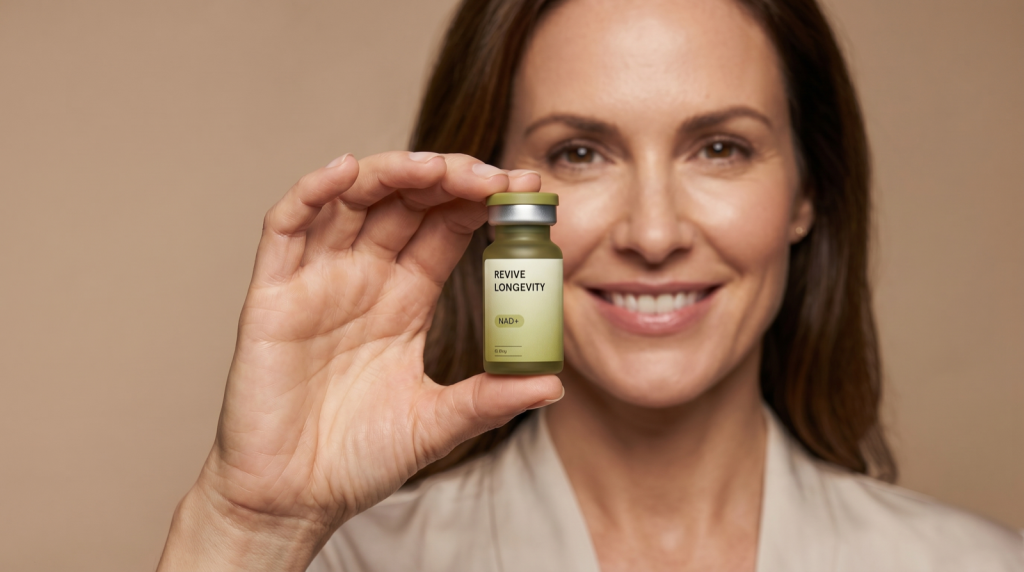
Revive Longevity treats NAD+ as a provider-guided decision, not a self-prescribed quick fix. Any NAD+ offered through Revive is a compounded preparation that is not FDA-approved, and the FDA has not evaluated it for safety, quality, or efficacy. A licensed provider reviews your history and goals, explains what the evidence does and does not support for you specifically, and determines whether any NAD+ approach is appropriate, with the understanding that benefits and timelines vary by person and are never guaranteed. You can learn more about the process on our how it works page.
Frequently asked questions
Is NAD+ a hormone or a hormone replacement for women?
No. NAD+ is a coenzyme involved in cellular energy metabolism and DNA repair, not a hormone. It is not a form of hormone replacement therapy and does not replace estrogen, progesterone, or testosterone.
Does NAD+ help with weight loss or energy in women?
The evidence does not establish NAD+ as a weight-loss or energy treatment. The most-cited human trial in postmenopausal women tested oral NMN and reported improved muscle insulin sensitivity, with no change in body weight or body composition. Claims of more energy or fat loss are not supported by that study, and individual results vary.
Is NAD+ FDA-approved?
Injectable and IV NAD+ are compounded and not FDA-approved; the FDA has not evaluated them for safety, quality, or efficacy. NMN, an oral precursor, is a lawful dietary-supplement ingredient as confirmed by the FDA in September 2025, but being a lawful supplement is not the same as being an approved drug for any condition.
Can NAD+ improve menopause symptoms or fertility?
NAD+ has not been shown to treat menopause symptoms or to improve fertility in women. Some animal and laboratory studies on ovarian aging are intriguing, but those findings have not been established in humans. Menopause and fertility decisions should be made with a qualified clinician.
Should I choose oral NMN or an NAD+ infusion?
They are different products with different regulation and different (limited) evidence, so there is no universal answer. A licensed provider can help you weigh your goals, health history, and the safety considerations of an injectable versus a supplement. Individual results vary.
Sources
- Nature Metabolism (2026): Human whole-blood NAD+ levels do not vary with age or lifestyle interventions
- Science (2021), Yoshino et al.: Nicotinamide mononucleotide increases muscle insulin sensitivity in prediabetic women
- Natural Products Association (September 2025): FDA reinstates NMN as a lawful dietary-supplement ingredient
- FDA: Compounding and the FDA (compounded drugs are not FDA-approved)
- FDA (2019): Warning to compounders not to use Letco Medical L-glutathione for sterile drugs (endotoxin contamination)
- Immunity & Ageing (2023): Impact of NAD+ metabolism on ovarian aging (animal and laboratory research)
- NASEM (2020): The Clinical Utility of Compounded Bioidentical Hormone Therapy
Considering NAD+? Start with a provider evaluation.
If you want to understand whether an NAD+ approach fits your goals, the next step is a conversation with a licensed provider, not a purchase. Request an evaluation to review your history, the current evidence, and your options.
Revive’s NAD+ is a compounded preparation. Compounded products are not FDA-approved, and the FDA has not evaluated them for safety, quality, or efficacy. Treatment is available only after evaluation by a licensed provider and requires a prescription where applicable. This article is educational information, not medical advice. Individual results vary, and no specific outcome is guaranteed.