Sermorelin Dosage: How It Is Dosed, Titrated, and Monitored
June 13, 2026 · Hormone Health
Medically reviewed by Diana Medina, PA-C, board-certified Physician Associate · Last reviewed June 14, 2026
Key takeaways
Sermorelin is given by subcutaneous injection. In its FDA-approved pediatric history and pivotal trial it was dosed once daily, and the studied timing was at bedtime, but that figure was a pediatric study dose and is reference-only, not a recommendation for adult wellness use.
The bedtime-dosing rationale is often described as aligning with the body’s growth hormone (GH) pulse around the onset of deep sleep. This is a proposed physiologic rationale rather than proof that evening sermorelin is necessary or superior, and the cited physiology notes this sleep-onset surge contributes more of daily GH output in men than in women.
Sermorelin dosage is individualized and provider-determined. Titration and follow-up are intended to be guided by a clinician and by laboratory monitoring, commonly serum IGF-1, and are not something to self-direct.
Because the original brand product (Geref) is no longer marketed, sermorelin dispensed today is typically a compounded preparation, which is not an FDA-approved finished drug for anti-aging or wellness use. Whether it may be compounded is governed by evolving and contested federal rules.
Sermorelin dosage is generally administered as a once-daily subcutaneous injection, with the strength and timing specified by a licensed provider and adjusted over time based on clinical response and laboratory results such as serum IGF-1. Sermorelin is a synthetic analog of the first 29 amino acids of growth hormone-releasing hormone (GHRH 1-29) that stimulates the patient’s own pituitary gland to release endogenous growth hormone by binding GHRH receptors. Because dosing is highly individualized, the practical answer to “how much sermorelin” is that it depends on the person, the indication, and the prescriber’s protocol. This article is educational and is not medical advice. Only a licensed clinician who has evaluated you can determine whether sermorelin is appropriate and what dose to use.
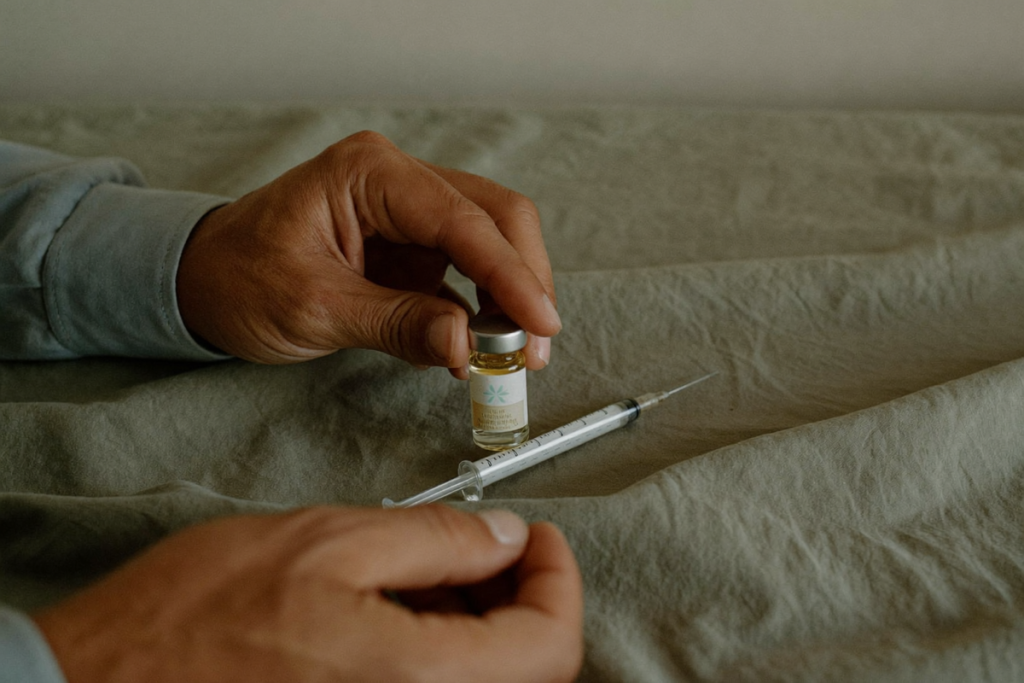
Sermorelin is given by subcutaneous injection with strength and timing set by a licensed provider. Educational image; not medical advice.
How is sermorelin administered?
Sermorelin is delivered by subcutaneous injection, meaning into the fatty tissue just under the skin. In the product’s FDA-approved history and in the pivotal clinical study, the route and frequency were once daily, and the studied timing was at bedtime (Geref International Study Group, 1996). For adult or wellness use today, the specific strength, frequency, and timing are set by the prescribing provider and are individualized to the patient rather than fixed by a single universal protocol.
It is worth being precise about what is and is not established. The only label and study-grade dosing figure comes from pediatric growth hormone deficiency (GHD) research, where the agent was dosed at 30 micrograms per kilogram per day. Numbers circulated on commercial peptide or clinic websites for adult use do not come from FDA labeling or peer-reviewed primary literature, so they should not be treated as a recommendation.
What is the reference dose from the clinical trial?
The clearest published dosing reference for sermorelin comes from a pediatric trial in children with growth failure due to idiopathic GHD. In that study, GHRH-(1-29) was given at 30 micrograms per kilogram per day, subcutaneously, at bedtime, and mean height velocity rose from 4.1 cm per year at baseline to 8.0 and 7.2 cm per year at 6 and 12 months (J Clin Endocrinol Metab, 1996).
This figure is included strictly as a reference point. It describes a weight-based pediatric dose for a growth disorder and is not a recommendation for adult wellness use, where the indication, goals, and physiology differ. Individual results vary, and any dosing decision belongs to a licensed provider.
Parameter
What the record shows (reference-only)
Route
Subcutaneous injection
Frequency
Once daily in the labeled and studied use
Studied timing
At bedtime (pediatric trial)
Trial dose
30 micrograms/kg/day (pediatric GHD; reference-only, not a recommendation)
Adult/wellness dose
Provider-determined and individualized; not defined by FDA labeling
Monitoring
Clinical response plus laboratory follow-up such as serum IGF-1, provider-directed
Why is bedtime dosing often suggested?
The proposed rationale for evening or bedtime dosing is that a large and reproducible natural GH pulse tends to occur within minutes of the onset of slow-wave (deep) sleep, with maximal release in the second half of the night (Endotext, Normal Physiology of GH in Adults). The idea is that timing a GHRH analog to align with this window may work with the body’s own rhythm. Notably, the same source indicates this sleep-onset surge represents the bulk of daily GH output in men but only a fraction of total daily GH release in women, so the magnitude of this pulse is not uniform across patients.
That physiology is well described, but it is important not to overstate it. The claim that bedtime sermorelin is therefore necessary or superior to other timing is an inference, not a settled conclusion. The studied timing happened to be at bedtime; whether that timing materially changes outcomes in adult use is a question a provider weighs case by case.
Titration is provider-determined and guided by laboratory follow-up such as serum IGF-1. Individual results vary.
How is sermorelin dosage titrated and monitored?
Titration means adjusting the dose over time based on how a patient responds. With sermorelin, that process is intended to be clinician-led and lab-guided rather than self-directed. Sermorelin works upstream of growth hormone, so providers commonly track serum IGF-1 as a downstream marker, alongside clinical assessment, to inform whether and how to adjust therapy. Published reviews describe IGF-1 monitoring chiefly in the context of growth hormone dosing, and specific IGF-1 targets for sermorelin are protocol-driven rather than defined by the label (Clin Interv Aging review).
Readers should not self-dose, self-titrate, or self-interpret laboratory results. Dosing adjustments and monitoring intervals are decisions for your licensed provider, who can interpret your labs in the context of your overall health.
What are the contraindications, interactions, and side effects?
Per the historical Geref prescribing information, sermorelin is contraindicated in patients with known hypersensitivity to sermorelin or to any excipient in the formulation (RxList, Sermorelin Acetate). The Geref labeling also describes several medications that can interfere with the body’s GH-secretory response. These interactions are noted chiefly in the context of sermorelin’s diagnostic use, where the goal is to assess pituitary GH release and these agents can alter the test result. Concomitant glucocorticoid therapy may inhibit the response. The label further notes that the response can be affected by cyclooxygenase inhibitors (for example aspirin or indomethacin), thyroid-lowering or antithyroid agents (for example propylthiouracil), muscarinic antagonists (for example atropine), insulin, and somatostatin or agents that influence somatostatin and dopaminergic pathways (for example clonidine and levodopa). The direction of effect is not uniform: some agents such as clonidine, levodopa, and insulin-induced hypoglycemia can transiently raise GH rather than blunt it (Geref prescribing information, Drugs.com). Because these interactions matter for both interpreting results and overall safety, share your full medication list with your provider.
Regarding side effects, the most common treatment-related adverse event reported with sermorelin is a local injection-site reaction such as pain, swelling, or redness, occurring in roughly 1 in 6 patients. Other reactions, each reported in under 1% of patients, include headache, flushing, difficulty swallowing (dysphagia), dizziness, hyperactivity, somnolence, and hives (urticaria). A large proportion of patients develop anti-sermorelin (anti-GRF) antibodies at least once during treatment; the clinical significance is unclear, a positive result often reverts to negative, and no clear effect on growth or a specific adverse-reaction pattern has been established. People who are pregnant or breastfeeding, who have a history of malignancy, or who have other significant medical conditions should discuss those high-risk factors with a provider before considering therapy.
Is sermorelin FDA-approved, and can it be compounded?
Sermorelin’s only U.S. brand, Geref (sermorelin acetate), was an FDA-approved injection indicated for treating idiopathic growth hormone deficiency in children with growth failure, plus a lower-dose form used as a diagnostic agent for GH deficiency. It is no longer marketed; the manufacturer discontinued it in the late 2000s. Per the regulatory record, FDA was notified the diagnostic form was being discontinued in 2008, and approval of the New Drug Applications was withdrawn in 2009. Importantly, the FDA determined that Geref was not withdrawn for reasons of safety or effectiveness, and the discontinuation was a commercial decision (Federal Register, 2013). Geref was never FDA-approved for anti-aging or adult GH optimization; any such use is off-label.
Because the approved finished product is no longer marketed, sermorelin dispensed today is typically a compounded preparation, which is not an FDA-approved finished drug product for anti-aging, weight loss, or wellness use. Whether sermorelin may lawfully be compounded is determined by 503A and 503B bulk-substance rules and by the judgment of the pharmacy and prescriber. Its eligibility has been the subject of evolving and contested federal policy rather than a settled legal conclusion, and the peptide-compounding landscape remains in flux (Frier Levitt, 2025). For perspective, this evolving framework is also relevant to other compounded categories such as GLP-1 medications, where end-of-shortage developments in 2024 and 2025 (the FDA removed tirzepatide from the shortage list in October 2024 and declared the semaglutide shortage resolved in February 2025, with compounding grace periods ending by May 2025) tightened the conditions under which compounding may occur.
Frequently asked questions
What is the standard sermorelin dosage?
There is no single standard adult dose defined by FDA labeling. The only label and study-grade figure is the pediatric trial dose of 30 micrograms per kilogram per day given subcutaneously at bedtime, which is reference-only and not a recommendation. For adult or wellness use, the dose is individualized and determined by a licensed provider.
How is sermorelin injected?
Sermorelin is given as a subcutaneous injection, into the tissue just beneath the skin. In its labeled and studied use it was administered once daily, with the studied timing at bedtime. Your provider specifies the exact strength, frequency, and technique for your situation.
Why is sermorelin sometimes taken at night?
The proposed rationale is that a large natural growth hormone pulse tends to occur shortly after the onset of deep sleep, so evening dosing is thought to align with that rhythm. The cited physiology notes this contributes more of daily GH output in men than in women. This is a physiologic rationale rather than proof that bedtime dosing is required or superior.
How is sermorelin dosage adjusted over time?
Adjustments are intended to be made by a clinician based on your response and laboratory follow-up, commonly serum IGF-1. Specific targets are protocol-driven, not label-defined, and you should not self-titrate or self-interpret labs.
Is sermorelin FDA-approved?
The original brand, Geref, was FDA-approved only for pediatric GH deficiency treatment and diagnosis, and it is no longer marketed. The FDA found it was not withdrawn for safety or effectiveness reasons. Sermorelin available today is typically compounded and is not an FDA-approved finished product for wellness use.
Sermorelin at Revive Longevity
Curious whether sermorelin could fit your goals? Start with an online assessment. A licensed provider reviews your information and determines whether sermorelin is appropriate for you. Sermorelin is prescribed off-label by licensed providers, and dosing is individualized to each patient.
FDA / Federal Register. Determination That GEREF (Sermorelin Acetate) Injection Was Not Withdrawn for Reasons of Safety or Effectiveness (2013). federalregister.gov
Geref International Study Group. Once daily subcutaneous GHRH therapy accelerates growth in GH-deficient children. J Clin Endocrinol Metab, 1996. pubmed.ncbi.nlm.nih.gov
Endotext (NCBI Bookshelf). Normal Physiology of Growth Hormone in Adults. ncbi.nlm.nih.gov

 Medically reviewed by Diana Medina, PA-C, board-certified Physician Associate · Last reviewed June 14, 2026