
Sermorelin Side Effects and Safety: What the Evidence Actually Shows

 Medically reviewed by Diana Medina, PA-C, board-certified Physician Associate · Last reviewed June 14, 2026
Key takeaways
- On the historical FDA label for sermorelin acetate (Geref), the most common treatment-related side effect was a local injection-site reaction (pain, swelling, or redness), reported in about 1 patient in 6.
- All sermorelin available in the United States in 2026 is compounded under sections 503A/503B. Compounded sermorelin is not FDA-approved and has not been evaluated by the FDA for safety, quality, or efficacy.
- Geref was discontinued for commercial/manufacturing reasons, not for safety or effectiveness, per an FDA determination dated March 4, 2013.
- The human evidence base is small and dated; there are no modern Phase III trials of compounded sermorelin for adult or anti-aging use, so long-term safety data are limited and any benefits are individual and provider-determined.
The most commonly reported sermorelin side effect is a mild, short-lived reaction at the injection site, pain, swelling, or redness, which occurred in roughly 1 patient in 6 on the historical sermorelin acetate (Geref) prescribing information. Other treatment-related reactions on the subcutaneous label were generally mild and uncommon (each under 1%), including headache, facial flushing, dizziness, difficulty swallowing, and hives. Nausea, vomiting, altered taste, and pallor were noted only for the intravenous Geref Diagnostic formulation, not for subcutaneous treatment use. Sermorelin is a synthetic 29-amino-acid fragment of growth-hormone-releasing hormone (GHRH 1-29) that prompts your own pituitary gland to release growth hormone, rather than supplying growth hormone from outside the body. Below is what the limited, mostly dated human evidence actually says, with every figure tied to its exact source and population.
What is sermorelin, and why does its regulatory status matter for safety?
Sermorelin is a synthetic peptide corresponding to the first 29 amino acids of human growth-hormone-releasing hormone (GHRH 1-29). It binds the GHRH receptor on pituitary somatotrophs and stimulates the body’s own growth-hormone secretion. It was once FDA-approved as Geref (for pediatric idiopathic growth-hormone deficiency) and Geref Diagnostic (a growth-hormone stimulation test), both held by EMD Serono.
Those approvals no longer exist. EMD Serono notified the FDA on December 2, 2008 that it was discontinuing Geref, and the FDA withdrew approval of both new drug applications effective June 18, 2009. In a Federal Register determination dated March 4, 2013, the FDA found that Geref was not withdrawn for reasons of safety or effectiveness; the discontinuation was a commercial and manufacturing decision tied to active-ingredient supply.
This matters for safety because every sermorelin product dispensed in the U.S. today is compounded under sections 503A (patient-specific) or 503B (outsourcing facility). According to compounding-pharmacy guidance, compounded sermorelin is not FDA-approved and has not been evaluated by the FDA for safety, quality, or efficacy. It is prescription-only. Compounded products should never be assumed equivalent to an FDA-approved drug.
What are the most common sermorelin side effects?
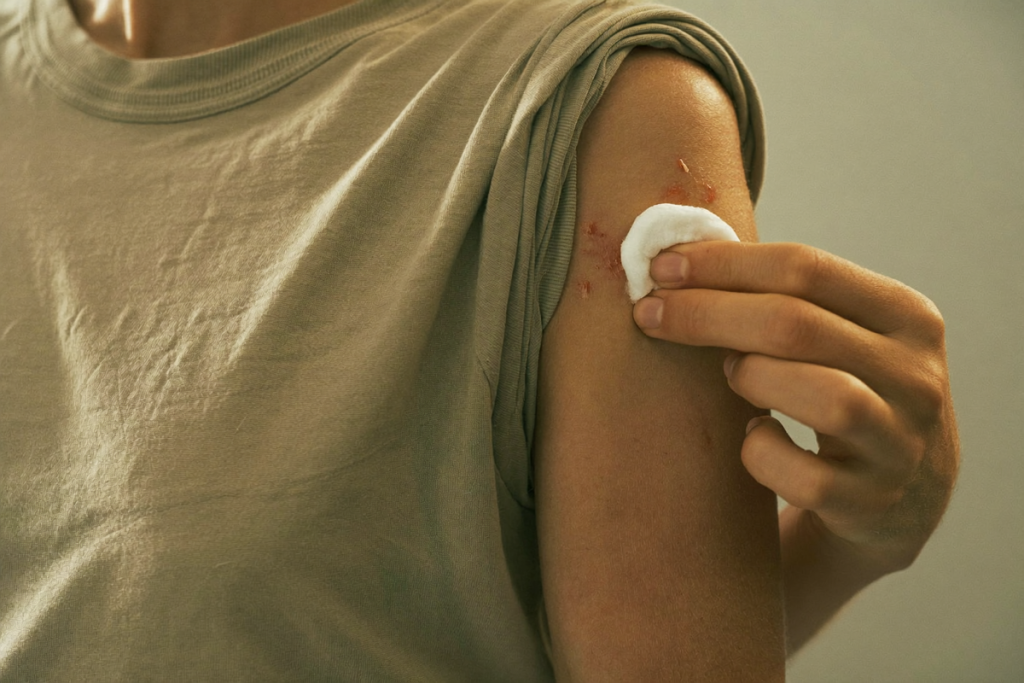
The clearest human safety data come from the historical Geref/sermorelin acetate label, derived from a pediatric growth-hormone-deficiency treatment population. On that label, the single most common treatment-related adverse event was a local injection-site reaction, reported in about 1 patient in 6 (roughly 16%). Other reactions were described as generally mild.
| Reported reaction | Approximate frequency / note | Source population |
|---|---|---|
| Injection-site reaction (pain, swelling, redness) | ~1 in 6 patients (~16%) | Historical Geref human label (pediatric GH-deficiency treatment) |
| Headache | Reported; generally mild | Historical Geref human label |
| Facial flushing | Reported; generally mild | Historical Geref human label |
| Dizziness | Reported; generally mild | Historical Geref human label |
| Nausea / vomiting | Reported; generally mild | Geref Diagnostic formulation (intravenous diagnostic route) |
| Hives (urticaria), difficulty swallowing | Reported; generally mild | Historical Geref label (subcutaneous treatment, each <1%) |
| Altered taste (dysgeusia), pallor | Reported; generally mild | Geref Diagnostic formulation (intravenous diagnostic route) |
| Chest tightness, difficulty swallowing | Reported with the IV diagnostic route | Geref Diagnostic formulation |
Note that the chest-tightness and swallowing reactions were noted for the intravenous diagnostic formulation (Geref Diagnostic), not the subcutaneous treatment use. These frequencies come from a decades-old pediatric label and may not predict what happens in adults using compounded sermorelin, for which no comparable controlled safety dataset exists.
Are there serious risks or allergic reactions?
On the historical label, a large proportion of patients developed anti-GRF (anti-sermorelin) antibodies at least once during treatment. Importantly, those antibodies were not associated with a specific adverse-reaction profile or with impaired growth, and no generalized allergic reactions were reported in the labeled population.
The one absolute contraindication on the label is known hypersensitivity to sermorelin or to product excipients. As with our coverage of enclomiphene side effects, an individual’s risk depends heavily on their own medical history, which is why a licensed provider should review your case before prescribing.
Who should avoid sermorelin or use extra caution?
Several label-derived cautions are worth raising with a clinician. Per the compounding-pharmacy summary and the historical label, untreated hypothyroidism blunts the growth-hormone response (thyroid function should be checked before and during therapy); high-dose glucocorticoids can inhibit the growth-hormone response; and somatostatin or somatostatin analogs oppose growth-hormone release. Because growth hormone antagonizes insulin, patients with diabetes need monitoring.
Compounding-pharmacy guidance also advises caution against use in active malignancy and in pregnancy. These are not absolute medical pronouncements for your situation, they are reasons to consult a provider. If you are weighing hormone-related options more broadly, see our overview of signs you may need hormone therapy.
How long does sermorelin stay in the body?
Sermorelin is short-acting by design. In a human pharmacokinetic study of the unmodified GHRH-(1-29)-NH2 peptide, the sequence sermorelin is based on, the plasma disappearance half-time was approximately 4.3 plus or minus 1.4 minutes in 10 normal men. The commonly cited functional half-life for sermorelin is an approximate range of about 10 to 20 minutes; treat that as a rough figure rather than a precise measurement.
This brief duration is the point: rather than flooding the body with growth hormone, sermorelin produces a short, pulse-like stimulus on the pituitary, intended to work with the body’s own feedback loops. It does not establish that any particular benefit will follow.

What does the human efficacy evidence actually show?
Here the evidence is genuinely thin, and a common citation trap is worth flagging. A frequently referenced 16-week aging randomized trial (Khorram, Laughlin, Yen, JCEM 1997; n=19 age-advanced men and women) reported increased nocturnal growth hormone/IGF-1 and modest lean-mass and well-being changes. But that study administered the [Nle27]GHRH-(1-29)-NH2 analog, not plain sermorelin, so its body-composition and well-being numbers cannot be attributed to sermorelin.
Likewise, data on other GHRH-related drugs such as tesamorelin or CJC-1295 describe different molecules and cannot be imported as sermorelin’s results. The honest summary: the human sermorelin evidence rests on 1990s pediatric trials plus small aging studies, there are no modern Phase III trials of compounded sermorelin for adult or anti-aging use, and long-term safety data are limited. Any benefits are individual, provider-determined, and not guaranteed. For a fuller picture, see our pages on sermorelin before and after and sermorelin dosage. If you are comparing peptide options for body composition, our peptides for weight loss overview adds context.
Does the FDA’s 2026 peptide action change anything for sermorelin?
In April 2026, the FDA removed 12 peptides from Category 2 of the interim 503A bulks list and scheduled PCAC review. Sermorelin was not among the named peptides, and removal from Category 2 does not by itself authorize compounding. This action does not expand sermorelin’s availability or change its regulatory status; it remains a compounded, non-FDA-approved, prescription-only product.
Frequently asked questions
What is the most common side effect of sermorelin?
On the historical sermorelin acetate (Geref) label, the most common treatment-related side effect was a local injection-site reaction, pain, swelling, or redness, reported in about 1 patient in 6. Other treatment-related reactions, such as headache, flushing, and dizziness, were generally mild and each occurred in under 1% of patients.
Is sermorelin FDA-approved?
No. The previously approved product, Geref, had its approvals withdrawn effective June 18, 2009. All sermorelin in the U.S. today is compounded under sections 503A/503B, is not FDA-approved, is prescription-only, and has not been evaluated by the FDA for safety, quality, or efficacy.
Was Geref pulled from the market for safety reasons?
No. In a determination dated March 4, 2013, the FDA found that Geref was not withdrawn for reasons of safety or effectiveness. The manufacturer, EMD Serono, discontinued it for commercial and manufacturing reasons related to active-ingredient supply.
Can sermorelin cause an allergic reaction?
The historical label lists known hypersensitivity to sermorelin or its excipients as a contraindication. Many patients developed anti-sermorelin antibodies during treatment, but these were not tied to a specific adverse-reaction pattern, and no generalized allergic reactions were reported in the labeled population. Discuss any allergy history with your provider.
How long does sermorelin last in the body?
It is very short-acting. The unmodified GHRH-(1-29)-NH2 peptide had a plasma disappearance half-time of about 4.3 minutes in a human study of 10 men, and sermorelin’s commonly cited functional half-life is an approximate 10-to-20-minute range.
Are sermorelin benefits guaranteed?
No. The human evidence is small and dated, with no modern Phase III trials of compounded sermorelin for adult or anti-aging use. Any benefits are individual, provider-determined, and variable. This article is educational information, not medical advice.
Considering sermorelin? Start with a provider review
If you want to understand whether sermorelin is appropriate for you, complete an online assessment and a licensed provider will evaluate your history, goals, and safety considerations.
Prescription only. Compounded, not FDA-approved. The FDA has not evaluated compounded sermorelin for safety, quality, or efficacy. Individual results vary.
Sources
- RxList. Sermorelin Acetate drug monograph (FDA label-derived adverse reactions, contraindications). https://www.rxlist.com/sermorelin-acetate-drug.htm
- FDA / Federal Register. Determination That GEREF (Sermorelin Acetate Injection) Was Not Withdrawn for Safety or Effectiveness (March 4, 2013). https://www.federalregister.gov/documents/2013/03/04/2013-04827/determination-that-geref-sermorelin-acetate-injection-05-milligrams-basevial-and-10-milligrams
- Empower Pharmacy. Sermorelin Acetate Injection (compounded; drug interactions, contraindications, not-FDA-approved statement). https://www.empowerpharmacy.com/compounding-pharmacy/sermorelin-acetate-injection/
- Campbell RM, et al. D-Ala2 substitution in GHRH-(1-29)-NH2 increases half-life and decreases clearance in normal men (human PK; disappearance half-time ~4.3 min). PubMed 7962295. https://pubmed.ncbi.nlm.nih.gov/7962295/
- Khorram O, Laughlin GA, Yen SSC. Endocrine and metabolic effects of long-term [Nle27]GHRH-(1-29)-NH2 in age-advanced men and women (analog, not sermorelin). J Clin Endocrinol Metab (1997);82(5):1472-1479. https://academic.oup.com/jcem/article-abstract/82/5/1472/2823341
- Wikipedia. Sermorelin (identity, GHRH 1-29 mechanism, Geref history; inline-referenced). https://en.wikipedia.org/wiki/Sermorelin
- Orrick. FDA Announces Removal of 12 Peptides from Category 2 and Schedules PCAC Meetings (April 2026 regulatory context). https://www.orrick.com/en/Insights/2026/04/FDA-Announces-Removal-of-12-Peptides-from-Category-2-and-Schedules-PCAC-Meetings
- FDA. Bulk Drug Substances Used in Compounding Under Section 503A of the FD&C Act. https://www.fda.gov/drugs/human-drug-compounding/bulk-drug-substances-used-compounding-under-section-503a-fdc-act