Sermorelin Before and After: An Honest Look at What People Actually Report
June 13, 2026 · Hormone Health
Medically reviewed by Diana Medina, PA-C, board-certified Physician Associate · Last reviewed June 14, 2026
Key takeaways
The honest answer on sermorelin before and after is that high-quality evidence is limited, small, and mostly dated, so no reliable percentage outcomes exist and any reported changes are anecdotal and not guaranteed.
Sermorelin is a synthetic GHRH analog that prompts your own pituitary to release growth hormone; it is not the same as injected human growth hormone and does not act directly on growth hormone receptors.
There is no FDA-approved sermorelin product on the US market today; every current prescription is compounded and used off-label, and its compounding status is contested and under FDA review in 2026.
Any use should be supervised by a licensed provider who screens for contraindications and monitors lab markers such as IGF-1; individual results vary widely.
When people search for sermorelin before and after, they usually want a clear timeline of guaranteed results. The honest answer is more cautious. Sermorelin is a synthetic analog of growth hormone-releasing hormone, and the published human evidence for adult use is limited, small in size, and largely from the 1990s. There are no large modern randomized trials showing durable anti-aging, fat-loss, muscle, or quality-of-life changes, and no trustworthy percentage figures exist. What you will find below is a careful summary of what is sometimes self-reported over weeks to months, clearly framed as anecdotal and not promised, alongside the mechanism, the regulatory reality, and the full safety picture so you can have an informed conversation with a licensed provider.
What is sermorelin and how is it supposed to work?
Sermorelin is a synthetic 29-amino-acid analog of endogenous growth hormone-releasing hormone, often written as GHRH (1-29). It binds GHRH receptors on the somatotroph cells of the pituitary gland to stimulate your body’s own pulsatile growth hormone secretion, which in turn can raise hepatic IGF-1. Importantly, it does not act on the growth hormone receptor directly, and unlike injected recombinant human growth hormone, it works within and tends to preserve the hypothalamic-pituitary negative feedback loop. You can read a general overview of its structure and pharmacology at this reference summary.
Sermorelin has a very short plasma half-life of roughly 11 to 12 minutes because it is rapidly broken down by enzymes. That short window is one reason it has historically been given as a subcutaneous injection, often at night to loosely mimic the natural nocturnal pulse of growth hormone.
What does the evidence actually show?
This is where careful reading matters, because many blogs blur two different molecules. The single most relevant human trial of sermorelin itself, Vittone and colleagues in Metabolism (1997), gave 2 mg nightly subcutaneously for six weeks to 11 healthy men aged 64 to 76. It did increase nocturnal growth hormone and improved a couple of strength and endurance measures, but it did not significantly raise IGF-1 and did not meaningfully change body composition. The authors concluded that single nightly doses of GHRH are less effective than multiple daily doses. You can review that trial at its PubMed listing (PMID 9005976).
A frequently cited study describing increased skin thickness and a small but statistically significant increase in lean body mass in men only is often mislabeled as a sermorelin result. It is not. That paper, Khorram, Laughlin and Yen in the Journal of Clinical Endocrinology and Metabolism (1997), studied a different molecule, [Nle27]GHRH-(1-29)-NH2, a norleucine-substituted analog with roughly three times the potency of sermorelin. It is not appropriate to present those numbers as sermorelin before-and-after results, and we do not. Taken together, the body of evidence for sermorelin in healthy adults is limited, small, and short-term, and results are not guaranteed.
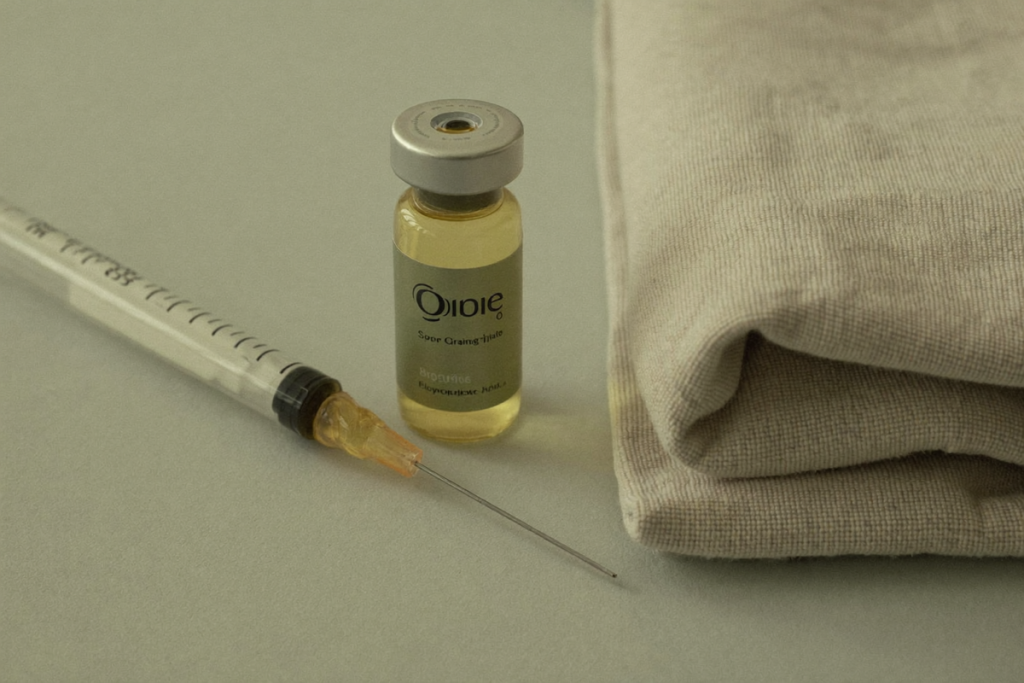
Sermorelin is a prescription compounded preparation given by subcutaneous injection under provider supervision. This image is illustrative and not a product depiction.
What is sermorelin’s FDA and compounding status?
Sermorelin was once FDA-approved under the brand name Geref. It was cleared first as a diagnostic agent for growth hormone secretion in 1990, then in 1997 for treating idiopathic growth hormone deficiency in children. The manufacturer voluntarily discontinued Geref in 2008, with US marketing approval withdrawn in 2009, for commercial and manufacturing reasons. An FDA Federal Register determination from 2013 explicitly states that Geref was not withdrawn for reasons of safety or effectiveness.
The practical reality today is that there is no FDA-approved sermorelin product on the US market. Every current prescription, including through telehealth, is a compounded preparation. That means it is not an FDA-approved finished drug, and its long-term safety and efficacy for anti-aging, body composition, sleep, or before-and-after outcomes have not been established in large modern trials.
Its compounding status is also unsettled. Sermorelin is not among the 12 peptides the FDA removed from interim Category 2 on April 15, 2026, and it is not affirmatively on the permitted 503A bulk substances list either. As legal analysts have noted, removal from Category 2 does not authorize compounding, and these peptide questions sit in a regulatory gray zone pending Pharmacy Compounding Advisory Committee meetings scheduled for July 23 to 24, 2026, with further review expected before the end of February 2027. In short, sermorelin is neither clearly FDA-sanctioned for compounding nor settled.
Sermorelin before and after: a commonly reported timeline
The table below summarizes patterns that some people describe anecdotally. These are not promised outcomes, are not established efficacy endpoints, and are not backed by reliable percentage figures. Experiences vary widely, and many people notice little or nothing. This is general education, not a prediction of your results.
Timeframe
Commonly reported (anecdotal, not guaranteed)
What providers typically do
Weeks 1 to 4
Some report deeper or more restful sleep; adjustment to injection-site sensations
Confirm technique, screen for side effects, set expectations
Weeks 4 to 8
Some report improved daytime energy, recovery, or mood
Check tolerability and adherence
Weeks 8 to 12
Some report subjective changes in body composition or skin
Discuss whether to continue and review goals
Months 3 to 6
Variable; many notice little change
Re-check IGF-1 and other labs to assess response and adjust dose
Because growth hormone is released in pulses and is hard to measure directly, providers generally track serum IGF-1, a more stable downstream marker, at baseline and periodically, for example around every three months, to titrate the dose toward an age-appropriate range. Some clinicians also monitor fasting glucose or HbA1c because growth hormone can affect insulin sensitivity.
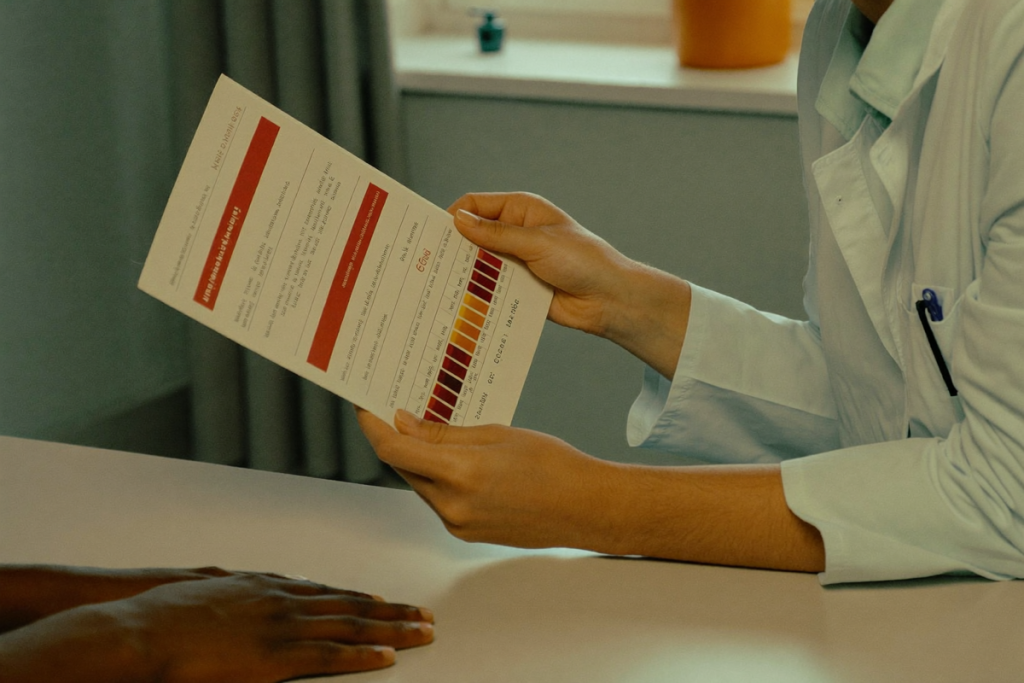
Providers typically track IGF-1 and other markers over months to guide any decision about sermorelin. Individual results vary and outcomes are not guaranteed.
What are the side effects and contraindications?
Most reported adverse effects are mild and local, especially in the first one to two weeks: injection-site redness, swelling, or itching, transient facial flushing, and headache. Less common effects include nausea, dizziness, hyperactivity, and drowsiness. Rare but serious hypersensitivity or allergic reactions, such as facial swelling, difficulty breathing, or a severe rash, require urgent medical care. In the long-term GHRH-analog study, transient elevated blood lipids were the notable adverse finding. A label-based safety overview is available at RxList.
Contraindications and cautions must be taken seriously and discussed fully with a prescriber. Sermorelin should be avoided in people with active cancer or a history of cancer, because growth hormone and IGF-1 can theoretically stimulate tumor growth. It should not be used during pregnancy or breastfeeding because of insufficient safety data, and it is contraindicated in anyone with known hypersensitivity to sermorelin or its excipients. Caution is warranted with hypothyroidism or untreated thyroid dysfunction, which can blunt the response, and in diabetes or impaired glucose tolerance. Glucocorticoids can blunt the growth hormone response. The original prescribing information also noted that somatostatin, thyroid-affecting agents, and certain anti-inflammatory drugs may blunt the response. This is one reason use should only occur under a licensed prescriber.
How should you think about expectations?
Sermorelin is a GHRH analog that works through your own growth hormone, not a weight-loss medication and not comparable to GLP-1 drugs or to tesamorelin, and it has no proven fat-loss endpoint. Given the limited, dated, and small evidence base, the most honest framing is that any benefit is uncertain, individual, and unproven, and that careful provider monitoring matters more than any timeline you read online.
Frequently asked questions
Is sermorelin FDA approved?
Not currently. The only ever FDA-approved sermorelin product, Geref, was discontinued in 2008 with approval withdrawn in 2009 for commercial reasons, not safety or efficacy. Every sermorelin prescribed today is compounded and not an FDA-approved finished drug.
How quickly do people notice changes with sermorelin?
There is no reliable timeline. Some people anecdotally report sleep or energy changes within the first weeks, but these are not proven, not guaranteed, and many notice little to nothing. Providers typically reassess with IGF-1 labs over three to six months.
Does sermorelin build muscle or burn fat?
The evidence does not support reliable before-and-after body composition claims. The main sermorelin human trial did not show meaningful body composition changes, and skin or lean-mass figures sometimes quoted online come from a different, more potent GHRH analog, not sermorelin.
How do providers monitor sermorelin?
Monitoring centers on serum IGF-1, drawn at baseline and periodically, to keep it in an age-appropriate range and guide dosing. Some clinicians also check fasting glucose or HbA1c because growth hormone can affect insulin sensitivity.
Who should not use sermorelin?
People with active or prior cancer, those who are pregnant or breastfeeding, and anyone with a known hypersensitivity should not use it. Caution applies with thyroid dysfunction and diabetes, and with drugs that blunt growth hormone, such as glucocorticoids and somatostatin analogs.
Sermorelin at Revive Longevity
If you are exploring sermorelin, the right first step is an online assessment so a licensed provider can review your history and determine whether sermorelin is appropriate for you. Sermorelin is prescribed off-label by licensed providers and is not FDA-approved for anti-aging or body composition.
Prescription only. Sermorelin is prescribed off-label by licensed providers and is not FDA-approved for anti-aging or body composition. Individual results vary.
Federal Register, FDA Determination that GEREF (Sermorelin Acetate) Injection was not withdrawn for reasons of safety or effectiveness, 2013. https://www.federalregister.gov/documents/2013/03/04/2013-04827/determination-that-geref-sermorelin-acetate-injection-05-milligrams-basevial-and-10-milligrams
Vittone J, et al. Effects of single nightly injections of growth hormone-releasing hormone (GHRH 1-29) in healthy elderly men. Metabolism. 1997;46(1):89-96. PMID 9005976. https://pubmed.ncbi.nlm.nih.gov/9005976/
Khorram O, Laughlin GA, Yen SSC. Endocrine and Metabolic Effects of Long-Term Administration of [Nle27]Growth Hormone-Releasing Hormone-(1-29)-NH2 in Age-Advanced Men and Women. J Clin Endocrinol Metab. 1997;82(5):1472-1479. https://academic.oup.com/jcem/article/82/5/1472/2823341
Orrick. FDA Announces Removal of 12 Peptides from Category 2 and Schedules PCAC Meetings, April 2026. https://www.orrick.com/en/Insights/2026/04/FDA-Announces-Removal-of-12-Peptides-from-Category-2-and-Schedules-PCAC-Meetings
FDA. Bulk Drug Substances Used in Compounding Under Section 503A of the FD&C Act. https://www.fda.gov/drugs/human-drug-compounding/bulk-drug-substances-used-compounding-under-section-503a-fdc-act
RxList. Sermorelin Acetate drug information (side effects, contraindications, interactions). https://www.rxlist.com/sermorelin-acetate-drug.htm
Which areas of your health are you looking to improve?
Select all that apply.
Just a few details so we can recommend the right next step.
We'll route you to the best fit and follow up with personalized guidance.


 Medically reviewed by Diana Medina, PA-C, board-certified Physician Associate · Last reviewed June 14, 2026