
Bioidentical Hormones: Pros and Cons

 Medically reviewed by Diana Medina, PA-C, board-certified Physician Associate · Last reviewed June 14, 2026
Key takeaways
- “Bioidentical” means structurally identical to the hormones your body makes. Many bioidentical hormones are FDA-approved (such as estradiol and micronized progesterone), while compounded bioidentical hormone therapy (cBHT) is not.
- The 2020 National Academies (NASEM) report found insufficient evidence to support the routine clinical utility of cBHT and recommended limiting it to two specific circumstances.
- FDA-approved bioidentical products are manufactured to a roughly plus-or-minus 10% potency standard; analyses of compounded preparations have found wider dose deviations and quality-test failures.
- All hormone therapy carries class risks that a licensed provider weighs against benefits; this article is educational information, not medical advice, and individual results vary.
Weighing the bioidentical hormones pros and cons starts with one distinction that most marketing blurs: “bioidentical” simply describes hormones that are structurally identical to the ones your body produces, such as 17-beta-estradiol and progesterone. That label says nothing about regulatory status. Many bioidentical hormones are FDA-approved and quality-controlled, while compounded bioidentical hormone therapy (cBHT) is not FDA-approved and has not been evaluated by the FDA for safety, quality, or effectiveness. Understanding which is which is the single most useful thing you can do before talking to a provider.
What does “bioidentical” actually mean?
A bioidentical hormone has the same molecular structure as a hormone made in the human body. Micronized progesterone, for example, is described in its FDA-approved Prometrium prescribing information as “chemically identical to progesterone of human ovarian origin.” That illustrates the central point: a hormone can be both identical to your own and FDA-approved at the same time. “Bioidentical” is a description of chemistry, not a guarantee of safety, naturalness, or superiority.
This matters because major medical bodies have repeatedly flagged “bioidentical equals natural and safer” as a marketing claim rather than an evidence-based one. The American College of Obstetricians and Gynecologists (ACOG) 2023 Clinical Consensus and the Endocrine Society position statement both note there is little or no high-quality evidence that compounded versions are safer or more effective than FDA-approved hormone therapy.
Are any bioidentical hormones FDA-approved?
Yes. Several bioidentical products are FDA-approved and are the guideline-preferred standard for their labeled menopause indications. FDA-approved estradiol tablets are indicated for moderate-to-severe vasomotor symptoms (hot flashes), moderate-to-severe vulvar and vaginal atrophy, hypoestrogenism, prevention of osteoporosis, and palliation in certain cancers, with labeling that directs using the lowest effective dose for the shortest appropriate duration. Micronized progesterone is FDA-approved to help prevent endometrial hyperplasia in postmenopausal women taking estrogen, and for secondary amenorrhea.
There is also a combination capsule: Bijuva (estradiol 1 mg + progesterone 100 mg), approved in October 2018 as the first FDA-approved combination of bioidentical estradiol and bioidentical progesterone for moderate-to-severe hot flashes in menopausal women with a uterus. These approvals mean the products were reviewed for safety, efficacy, and manufacturing quality, an important contrast with compounded preparations. If you are exploring symptom relief options, our overview of signs you may need hormone replacement therapy can help you frame the conversation with a provider.
What did the 2020 NASEM report conclude about compounded cBHT?
Compounded bioidentical hormone therapy is custom-mixed by a pharmacy and is not FDA-approved. The most authoritative review of it, the 2020 National Academies of Sciences, Engineering, and Medicine (NASEM) report delivered to the FDA on July 1, 2020, concluded there is “insufficient evidence to support the overall clinical utility of cBHT” for menopause or male hypogonadism symptoms. The report estimated the US cBHT market at roughly 26 to 33 million prescriptions per year, costing between $1 billion and $2 billion annually, general market context, not Revive pricing.
NASEM did not call for a ban. Instead, it recommended restricting cBHT to two circumstances: a documented allergy to an ingredient in an FDA-approved product, or a documented need for a dosage form not available among FDA-approved options. Patient preference alone, the committee said, is not a sufficient reason. cBHT remains a tool a provider may consider in those narrow situations.
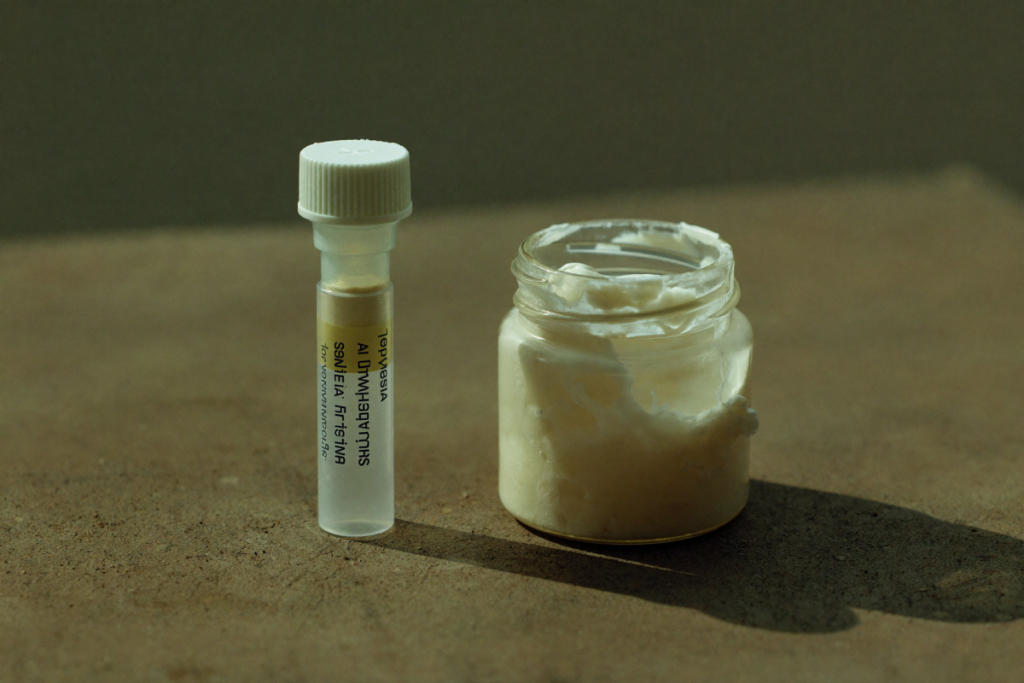
How consistent are compounded hormone doses?
Dose consistency is a frequently cited “con” for compounding. FDA-approved products must generally meet an approximately plus-or-minus 10% potency standard. The NASEM report, citing a 2019 analysis by Stanczyk and colleagues, documented wider deviations in compounded preparations, and the deviations differed by product type, so each should be read on its own rather than blended into a single number.
| Preparation | Measured potency deviation from label | Benchmark |
|---|---|---|
| Compounded estradiol capsules | -26% to +5% | FDA-approved: ~±10% |
| Compounded estradiol cream | -11% to +1.4% | |
| Compounded progesterone capsules | -9% to +31% | |
| Compounded progesterone cream | -5% to +12% |
Source: NASEM 2020, citing Stanczyk et al. 2019. Separately, an older 2001 FDA Limited Survey of compounded drugs broadly (not hormones specifically) found that 10 of 29 samples (34%) from 12 pharmacies failed standard quality tests, with 9 failing potency (measuring 59-89% of the labeled amount), versus a failure rate under 2% for FDA-approved products tested from 1996 to 2001. Because that survey covered compounded products in general, it should not be read as a hormone-only result.
What are the risks any hormone therapy can carry?
Whether bioidentical or not, all systemic hormone therapy carries class risks a provider must weigh, such as endometrial cancer with unopposed estrogen in a woman with a uterus and the potential for blood clots. The well-known Women’s Health Initiative (WHI) trials found increased risks of heart disease, stroke, clots, breast cancer, and dementia, but a crucial caveat applies: the WHI estrogen-plus-progestin arm used conjugated equine estrogen plus medroxyprogesterone acetate, which are not bioidentical hormones. Those specific risk numbers should be read as historical menopause-therapy context, not as figures generated by bioidentical estradiol or progesterone.
The regulatory warning landscape is also evolving. On November 10, 2025, HHS and the FDA initiated removal of boxed-warning statements on cardiovascular disease, breast cancer, and probable dementia from menopausal hormone therapy products. In February 2026 the FDA approved a first batch of six products with the updated labeling, with 29 companies having submitted proposed changes; the endometrial-cancer boxed warning remains on systemic estrogen-alone products. Because many drug labels still display the older warning during this transition, the exact warning text is provider- and product-specific, and you should review the current label with your clinician.

Where does testosterone fit in?
Testosterone is sometimes discussed alongside bioidentical hormones, but it occupies its own category. It is a DEA Schedule III controlled substance that requires a valid prescription, a diagnosis based on symptoms plus two low early-morning blood tests, and ongoing monitoring. In February 2025 the FDA issued class-wide labeling changes for testosterone products adding a blood-pressure warning and incorporating TRAVERSE trial results. In a menopause context specifically, ACOG notes there is no FDA-approved testosterone formulation for menopausal symptoms. If testosterone is on your radar, see our guides to TRT dosage and enclomiphene vs TRT, and discuss diagnosis and monitoring with a provider.
Pros and cons at a glance
| Consideration | FDA-approved bioidentical (e.g., estradiol, micronized progesterone, Bijuva) | Compounded cBHT |
|---|---|---|
| FDA review for safety/efficacy/quality | Yes | No |
| Manufacturing potency standard | ~±10% | Wider deviations reported (NASEM/Stanczyk) |
| Standardized warning labeling | Yes (currently in transition) | No standardized warning label |
| Evidence base | Supported for labeled indications | NASEM: insufficient evidence for routine use |
| Appropriate role | Guideline-preferred where suitable | NASEM: two specific circumstances only |
One more caution that cuts across both columns: the FDA and medical societies consider salivary hormone testing used to “tailor” dosing unreliable, so be wary of any program built around it. The right choice is provider-determined, and there are no efficacy guarantees, individual results vary.
Frequently asked questions
Are bioidentical hormones FDA-approved?
Some are and some are not. FDA-approved bioidentical products include estradiol, micronized progesterone, and the combination capsule Bijuva (estradiol 1 mg + progesterone 100 mg, approved October 2018). Compounded bioidentical hormone therapy (cBHT) is not FDA-approved, and the FDA has not evaluated compounded preparations for safety, quality, or effectiveness.
Are bioidentical hormones safer than conventional hormone therapy?
Not necessarily. ACOG, the Endocrine Society, and the FDA describe “bioidentical equals safer or more natural” as a marketing claim unsupported by high-quality evidence. All hormone therapy carries class risks a provider weighs individually, and outcomes vary by person. This is educational information, not medical advice.
Why do experts caution against compounded bioidentical hormones?
The 2020 NASEM report found insufficient evidence to support the routine clinical utility of cBHT and recommended limiting it to documented allergy to an FDA-approved product ingredient or a documented need for an unavailable dosage form. Analyses have also reported wider potency deviations in some compounded preparations than the roughly plus-or-minus 10% standard for FDA-approved products.
What does bioidentical hormone therapy treat?
FDA-approved bioidentical estradiol is labeled for moderate-to-severe hot flashes, vulvovaginal atrophy, hypoestrogenism, and osteoporosis prevention, using the lowest effective dose for the shortest appropriate duration. Whether any therapy is appropriate for you, and at what dose, is a decision for a licensed provider, and individual results vary.
Does insurance cover bioidentical hormones, and what do they cost?
Coverage and cost depend on the specific product, formulation, and your plan, and FDA-approved versus compounded status often matters. NASEM estimated the broader US cBHT market at roughly 26-33 million prescriptions and between $1 billion and $2 billion per year, which is general market context, not Revive pricing. For testosterone-specific questions, see our guides on what TRT costs and whether TRT is covered by insurance.
Is compounded bioidentical hormone therapy ever appropriate?
NASEM identified two circumstances where it may be considered: a documented allergy to an ingredient in an FDA-approved product, or a documented need for a dosage form not available among FDA-approved options. Patient preference alone is not considered a sufficient reason. A licensed provider determines whether either applies to you.
Talk to a licensed provider about hormone options
If you are weighing bioidentical hormone therapy, a Revive Longevity clinician can review your history, symptoms, and goals and discuss FDA-approved and other options that may fit. Start with a provider evaluation, no results are promised.
Request a provider evaluation →
Educational information, not medical advice. Hormone therapy is provider-determined and individual results vary. Some offerings are compounded and not FDA-approved; the FDA has not evaluated compounded preparations for safety, quality, or efficacy. Testosterone is prescription only, a controlled substance requiring a diagnosis and ongoing monitoring.
Sources
- National Academies of Sciences, Engineering, and Medicine. The Clinical Utility of Compounded Bioidentical Hormone Therapy: A Review of Safety, Effectiveness, and Use, Summary (2020). https://www.ncbi.nlm.nih.gov/books/NBK562875/
- National Academies of Sciences, Engineering, and Medicine. Compounded Bioidentical Hormone Preparations chapter (2020). https://www.ncbi.nlm.nih.gov/books/NBK562866/
- National Academies. Prescribers Should Restrict the Use of Non-FDA-Approved Compounded Bioidentical Hormones Except for Specific Medical Circumstances (2020). https://www.nationalacademies.org/news/prescribers-should-restrict-the-use-of-non-fda-approved-compounded-bioidentical-hormones-except-for-specific-medical-circumstances
- DailyMed. Estradiol tablet FDA prescribing information. https://dailymed.nlm.nih.gov/dailymed/drugInfo.cfm?setid=37f3094c-f02d-4a9c-8e30-2c4752bc62ed
- DailyMed. Prometrium (micronized progesterone) FDA prescribing information. https://dailymed.nlm.nih.gov/dailymed/drugInfo.cfm?setid=a451784e-f6a0-414a-8409-3407f1d1d086
- FDA label repository. BIJUVA (estradiol and progesterone) prescribing information, Initial U.S. Approval 2018. https://nctr-crs.fda.gov/fdalabel/services/spl/set-ids/bc52489a-5149-411d-9665-2c75405ad15d/spl-doc?hl=bijuva
- U.S. FDA. HHS Advances Women’s Health, Removes Misleading FDA Warnings on Hormone Replacement Therapy (Nov 10, 2025). https://www.fda.gov/news-events/press-announcements/hhs-advances-womens-health-removes-misleading-fda-warnings-hormone-replacement-therapy
- U.S. FDA. FDA Approves Labeling Changes to Menopausal Hormone Therapy Products (2026). https://www.fda.gov/news-events/press-announcements/fda-approves-labeling-changes-menopausal-hormone-therapy-products
- U.S. FDA. FDA Issues Class-Wide Labeling Changes for Testosterone Products (Feb 28, 2025). https://www.fda.gov/drugs/drug-safety-and-availability/fda-issues-class-wide-labeling-changes-testosterone-products
- American College of Obstetricians and Gynecologists. Clinical Consensus No. 6: Compounded Bioidentical Menopausal Hormone Therapy (Nov 2023). https://www.acog.org/clinical/clinical-guidance/clinical-consensus/articles/2023/11/compounded-bioidentical-menopausal-hormone-therapy
- Endocrine Society. Position Statement on Compounded Bioidentical Hormone Therapy. https://www.endocrine.org/advocacy/position-statements/compounded-bioidentical-hormone-therapy
- U.S. FDA. Report: Limited FDA Survey of Compounded Drug Products (2001). https://www.fda.gov/drugs/human-drug-compounding/report-limited-fda-survey-compounded-drug-products
- National Heart, Lung, and Blood Institute. Women’s Health Initiative (WHI). https://www.nhlbi.nih.gov/science/womens-health-initiative-whi