NAD+ Injections and IV: What the 2026 Evidence Actually Shows
June 13, 2026 · Longevity & Wellness
Medically reviewed by Diana Medina, PA-C, board-certified Physician Associate · Last reviewed September 9, 2026
Key takeaways
NAD+ is a coenzyme central to cellular energy and repair, but a large 2026 human study found that whole-blood NAD+ does not meaningfully decline with age, which challenges the popular claim that NAD+ falls by roughly half as we get older.
Injectable and IV NAD+ are compounded products. They are not FDA-approved, their safety and efficacy have not been evaluated by the FDA, and benefits reported for energy, focus, or anti-aging remain anecdotal and scientifically unproven.
The only published head-to-head infusion comparison is a small, retrospective, uncontrolled, commercially funded pilot in which all six NAD+ IV recipients reported side effects such as cramping, nausea, and chest pressure during the infusion. Tolerability conclusions from data this limited should be treated as preliminary, not established.
Sterility is a documented, not hypothetical, risk. NAD+ injection is contraindicated or used with caution in several populations, so a licensed provider should review your full history and medications before any decision.
NAD+ injections deliver nicotinamide adenine dinucleotide, a coenzyme involved in cellular energy production and DNA repair, directly into the body through a shot or an intravenous (IV) drip rather than through an oral capsule. People pursue them hoping to support energy, focus, recovery, or healthy aging. It is important to be clear from the outset that injectable and IV NAD+ are compounded products that are not FDA-approved, that the human evidence is limited and mixed, and that reported benefits are anecdotal and unproven. This guide explains what NAD+ is, what the most current 2026 data actually show, how injections and IV differ from oral NMN and NR, the side effects and contraindications to know, and why sourcing and sterility matter. It is educational information, not medical advice.
What is NAD+ and why does it matter?
NAD+ (nicotinamide adenine dinucleotide) is a coenzyme found in every living cell. It shuttles electrons during metabolism, helping convert food into usable energy, and it serves as a substrate for enzymes involved in DNA repair and cellular signaling, including sirtuins and PARPs. Because these pathways touch energy and repair, NAD+ has become a focal point in longevity research. That biological importance is well established. What is far less settled is whether boosting NAD+ through injections produces meaningful clinical benefits in healthy people, and the honest answer today is that this has not been demonstrated in large, controlled human trials.
Does NAD+ really decline with age?
This is where the popular story and the latest science diverge. For years, marketing claimed that NAD+ drops by roughly 50 percent with age. The most rigorous current data do not support that framing. A 2026 study in Nature Metabolism measured whole-blood NAD+ in more than 300 people across multiple independent human cohorts using a validated, high-resolution mass spectrometry method and found that whole-blood NAD+ levels were remarkably stable across age. Age explained only a negligible fraction of the variation, and the regression lines against age were essentially flat. The authors concluded that whole-blood NAD+ cannot be used to track human aging (Nature Metabolism, 2026).
The same study offers a likely reason older reports found a decline: pre-analytical handling artifacts. The authors reported that NAD+ measurements were highly sensitive to how blood samples were stored, because freezing and repeated freeze-thaw cycles can substantially reduce measured levels. In other words, much of the apparent age-related drop may reflect how samples were stored rather than real biology (NutraIngredients summary). Reassuringly, the assay still detected an expected rise in NAD+ in people taking nicotinamide riboside, so it works; age and common lifestyle changes simply did not move it.
None of this means NAD+ is unimportant inside cells, and older human data are genuinely mixed rather than uniformly negative. A 2022 cross-sectional study of 1,518 participants found a decline trend only before age 50, which disappeared after 50, with a significant inverse age association mainly in men over 60 (Frontiers in Endocrinology, 2022). The reasonable summary is that the evidence is nuanced, that blood NAD+ is a poor aging biomarker, and that the simple decline narrative should be retired.
Oral NMN and NR are precursors taken as supplements; reported benefits of NAD+ therapy are unproven and individual results vary.
How do NAD+ injections and IV differ from oral NMN and NR?
Oral supplements such as NMN (nicotinamide mononucleotide) and NR (nicotinamide riboside) are precursors, not NAD+ itself. Only a small fraction is absorbed intact, and much of an oral dose is metabolized by gut bacteria before it ever reaches cells, where it must still be converted into NAD+ through several enzymatic steps. Injections and IV instead place NAD+ (or an NR formulation) directly into the bloodstream, bypassing the gut and first-pass losses. Importantly, this does not mean oral precursors do not work. Human studies show oral NMN and NR do raise blood NAD+, although their absorption and metabolism remain incompletely understood (Science Advances). No head-to-head trial has shown that injections produce better clinical outcomes than oral precursors, so calling one route superior would overstate the evidence.
The three approaches also differ sharply in regulatory status. Oral NMN and NR are legally sold as dietary supplements; in fact, the FDA confirmed in September 2025 that beta-NMN is not excluded from the dietary-supplement definition, reversing an earlier 2022 position (Venable LLP analysis). Injectable and IV NAD+, by contrast, are not approved drugs. A fourth route sits outside this comparison altogether: topical NAD+ for skin, applied to the skin rather than swallowed or injected, is intended for the look of the skin rather than for systemic energy, focus, or aging outcomes.
Feature
NAD+ injection (subcutaneous/IM)
NAD+ or NR IV infusion
Oral NMN / NR
What you receive
NAD+ directly
NAD+ or NR directly
Precursor, converted to NAD+ in cells
Delivery route
Into tissue, bypasses gut
Into bloodstream, bypasses gut
Through gut; low intact absorption
Reported tolerability
Limited data; infusion side effects below likely apply at speed of delivery
In a small, retrospective, uncontrolled, commercially funded pilot, all 6 NAD+ IV recipients reported cramping, nausea, vomiting, raised heart rate, and chest pressure during infusion (Frontiers in Aging, 2026)
Generally well tolerated as a supplement; mild GI effects possible (supplement literature)
Before any specifics, the honest framing has to come first. The benefits people attribute to NAD+ injections and IV, including more energy, sharper focus, anti-aging effects, and support during addiction recovery, are anecdotal, self-reported, and scientifically unproven. There are no large, controlled human trials demonstrating clinical efficacy for these uses; existing human studies are small and often uncontrolled, and individual results vary considerably (Frontiers in Aging, 2026). With that caveat established, what some clients describe in clinic settings is a subjective sense of increased energy or mental clarity in the hours or days after a session. These accounts are testimonials, not evidence, and they cannot tell us whether the experience reflects NAD+, expectation, hydration, or other factors. No one should expect a specific result.
What are the side effects of NAD+ injections and IV?
The most informative human tolerability data come from a single small pilot, and its limitations are significant. In a retrospective study published in Frontiers in Aging (2026), with just six NAD+ IV recipients and eight NR IV recipients, all six NAD+ recipients reported moderate-to-severe abdominal cramping, diarrhea, nausea, vomiting, increased heart rate, throat pain, congestion, and chest pressure during the infusion, while only some NR recipients had minor tingling or cramping. The authors explicitly note a retrospective design, a small cohort, the absence of a placebo-controlled arm, and potential bias because the study was designed and run by a commercial entity that employed the researchers; they state plainly that the work is exploratory and does not imply causal inference (Frontiers in Aging, 2026). So these findings should be read as a preliminary signal, not a reliable side-effect profile.
Commonly described infusion-related effects include flushing, nausea, lightheadedness, headache, chest tightness, and cramping. Clinics often attribute these to the speed of the infusion and slow the drip to manage them, on the theory that rapid delivery triggers flushing through partial conversion to niacin. It is worth stressing that this rate-and-management explanation comes from clinic experience and small studies, not controlled trials, so it should be treated as a clinic-reported observation rather than an established mechanism.
Who should avoid NAD+ injections, and what about drug interactions?
Several populations should not use NAD+ injection without specialist clearance, or should avoid it. Based on compounded-product labeling, the main absolute contraindication is a known allergy or hypersensitivity to NAD+ or any ingredient in the formulation. Separately, some injectable formulations reconstituted with bacteriostatic water contain benzyl alcohol as a preservative, so anyone with a known benzyl alcohol sensitivity should ask their provider whether their specific formulation contains it. NAD+ injection is not recommended in pregnancy or breastfeeding because safety has not been established. It should generally be avoided in active cancer because of a theoretical risk of fueling tumor metabolism, unless an oncologist approves, and it should be used with caution or avoided in severe or uncontrolled liver disease, kidney disease, or unstable heart disease (compounded-product label).
Drug interactions are not well characterized. Compounded labeling reports no established significant drug-drug interactions, but that is not the same as proof that none exist (compounded-product label). Because the interaction profile is so poorly studied, the safe approach is to tell your prescriber about every medication and supplement you take, including any drugs that affect metabolism or mitochondrial function, and let them assess the combination, rather than assuming there are no interactions.
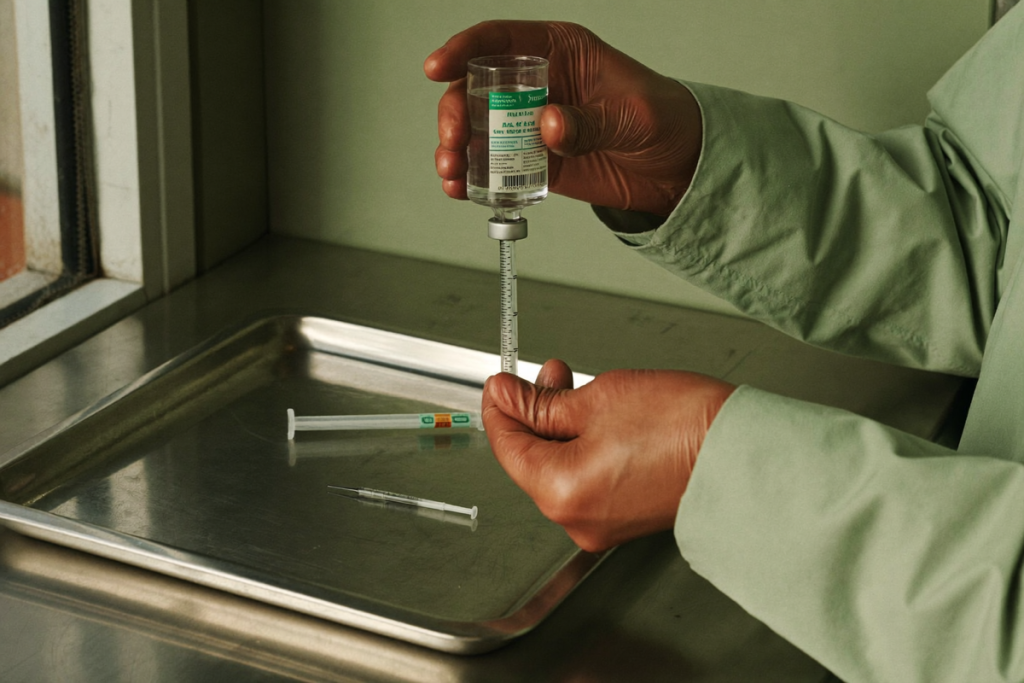
Injectable NAD+ is a compounded product; sterility and proper sourcing are essential. It is not FDA-approved.
Why do sourcing and sterility matter so much?
Because injectable NAD+ bypasses the gut and enters the body directly, contamination is a serious and documented hazard, not a hypothetical one. On October 21, 2025, the FDA announced a Class I recall, its most serious category, of compounded NAD+ injection lots distributed by GenoGenix LLC for elevated endotoxin levels; endotoxin contamination at that level can trigger severe inflammatory reactions such as fever, dangerously low blood pressure, and in severe cases sepsis (FDA Class I recall, Oct 2025). Separately, the FDA has warned that food-grade NAD+ sold by repackagers is not suitable for sterile compounding because of a high risk of microbial and endotoxin contamination, and it has received adverse-event reports of severe chills, shaking, vomiting, and fatigue consistent with excessive endotoxins (FDA compounding alert). The practical takeaway is that the pharmacy matters. Injectable NAD+ should be prepared only by a properly licensed 503A compounding pharmacy under a patient-specific prescription, or a registered 503B facility, using ingredients suitable for sterile compounding.
Frequently asked questions
Are NAD+ injections FDA-approved?
No. Injectable and IV NAD+ are compounded products prepared by 503A or 503B pharmacies, not FDA-approved drugs. Their safety and efficacy for these uses have not been evaluated by the FDA, and product labeling states this directly. Oral NMN and NR, by contrast, are sold as dietary supplements.
Do NAD+ injections work better than oral NMN or NR?
No head-to-head trial has shown that injections produce better clinical results than oral precursors. Injections and IV deliver NAD+ directly and bypass the gut, while oral NMN and NR are precursors with low intact absorption that still raise blood NAD+ in human studies. The bioavailability difference is real, but a benefit difference has not been proven.
Does NAD+ decline with age?
A large 2026 study in Nature Metabolism found whole-blood NAD+ was stable across age in more than 300 people, with age explaining only a negligible fraction of the variation. The authors attribute earlier reports of a steep decline largely to sample-handling artifacts. Older data are mixed, so the simple claim that NAD+ falls by half with age is not supported.
Who should not get NAD+ injections?
People with a known allergy to NAD+ or any ingredient in the formulation, including any preservative it may contain, should avoid them, as should those who are pregnant or breastfeeding. They should generally be avoided in active cancer unless an oncologist approves, and used with caution or avoided in severe liver, kidney, or unstable heart disease. Because interactions are not well characterized, review every medication and supplement you take with a licensed prescriber first.
Are the energy and anti-aging benefits proven?
No. Reported improvements in energy, focus, and aging are anecdotal, self-reported, and not demonstrated in large, controlled human trials. Individual results vary, and no specific outcome should be expected.
NAD+ at Revive Longevity
Curious whether NAD+ could fit your goals? The right first step is an online assessment, where a licensed provider reviews your health history and determines whether NAD+ therapy is appropriate for you. NAD+ therapy is not FDA-approved, and a provider decides whether it is a suitable option.
Trętowicz, Houtkooper, et al. Human whole-blood NAD+ levels do not vary with age or lifestyle interventions. Nature Metabolism (2026). https://www.nature.com/articles/s42255-026-01537-5
NutraIngredients. Blood NAD+ may not be a useful biomarker of aging after all (2026). https://www.nutraingredients.com/Article/2026/06/02/blood-nad-may-not-be-a-useful-biomarker-of-aging-after-all/
Cross-sectional NAD+ and age study, 1,518 participants. Frontiers in Endocrinology (2022). https://www.frontiersin.org/journals/endocrinology/articles/10.3389/fendo.2022.829658/full
Reyna, et al. Intravenous NAD+ versus nicotinamide riboside: a retrospective tolerability pilot study. Frontiers in Aging (2026), PMC12907335. https://pmc.ncbi.nlm.nih.gov/articles/PMC12907335/
FDA. FDA reminds compounders to use ingredients suitable for sterile compounding. https://www.fda.gov/drugs/human-drug-compounding/fda-reminds-compounders-use-ingredients-suitable-sterile-compounding
FDA Class I recall of compounded NAD+ injection (GenoGenix, LLC) for elevated endotoxin levels (Oct 2025). https://www.hmpgloballearningnetwork.com/site/pln/news/fda-issues-class-i-recall-nad-injection-due-elevated-endotoxin-levels
Venable LLP. FDA declares nicotinamide mononucleotide is a lawful dietary-supplement ingredient (2025). https://www.venable.com/insights/publications/2025/10/fda-declares-nicotinamide-mononucleotide-is

 Medically reviewed by Diana Medina, PA-C, board-certified Physician Associate · Last reviewed September 9, 2026