Medically reviewed by Diana Medina, PA-C, board-certified Physician Associate · Last reviewed June 14, 2026
Key takeaways
Per the FDA-approved tirzepatide labels (Zepbound and Mounjaro), the medication is a once-weekly subcutaneous injection given in one of three sites: the abdomen, the thigh, or the back of the upper arm.
You may self-inject the abdomen or thigh; the back of the upper arm is reserved for when another person gives the injection, per the label Instructions for Use.
Rotate your injection site with each weekly dose. The site can change without any dose adjustment because clinical pharmacology data show similar drug exposure across all three areas (mean absolute bioavailability about 80%).
This is general education, not medical advice. Always follow your specific product’s Instructions for Use and your prescriber’s and pharmacist’s guidance, and never start, change, or self-manage doses on your own.
If you are wondering where to inject tirzepatide, the FDA-approved labels give a clear, short answer: tirzepatide (the branded products Zepbound and Mounjaro) is a once-weekly subcutaneous injection placed in one of three sites: the abdomen, the thigh, or the back of the upper arm. According to the Zepbound prescribing information, a patient may self-inject the abdomen or thigh, while the back of the upper arm is for when another person delivers the dose. You inject once weekly, at any time of day, with or without meals, and you rotate the site with each dose. This article explains the technique and the reasoning behind it.
Where exactly do you inject tirzepatide?
Tirzepatide is a subcutaneous injection, meaning it goes into the fatty layer just under the skin rather than into muscle or a vein. The Mounjaro label and the Zepbound label both specify the same three areas. The distinction the label draws is important: the abdomen and thigh are the self-injection sites, and the back of the upper arm is described as a site for when another person administers the injection, because it is awkward to reach yourself.
Site
Who injects per label
Practical notes
Abdomen
You may self-inject
Stay roughly 2 inches (about 5 cm) away from the navel, per the product Instructions for Use.
Thigh (front/outer)
You may self-inject
Use the fleshy front or outer thigh, not the inner thigh or near the knee.
Back of upper arm
Another person should inject
Hard to reach for self-injection; reserved for a caregiver or helper.
Avoid injecting into skin that is tender, bruised, red, hard, or scarred. Your product’s Instructions for Use shows the exact target zones with diagrams, and devices differ (single-dose pen, KwikPen, and vial-and-syringe each have their own steps), so read the specific document that came with your medication.
Does the injection site change how well tirzepatide works?
No meaningful difference in drug exposure has been observed across the three sites. The Zepbound Clinical Pharmacology section (12.3) reports that similar exposure was achieved with subcutaneous administration in the abdomen, thigh, or upper arm, with a mean absolute bioavailability of about 80% (see the Zepbound label). That pharmacology is precisely why the label allows you to change the injection site without adjusting the dose. Your dose is determined by your prescriber, not by which site you use.
This is one way tirzepatide resembles other GLP-1-class injectables in the abdomen/thigh/upper-arm pattern. If you also take other subcutaneous medications, the same general technique applies; our overview of semaglutide injection sites walks through the parallel approach for that different drug.
A simple rotation log helps you move each weekly injection to a fresh spot, as the label advises.
How often and when do you inject tirzepatide?
Tirzepatide is injected once weekly, at any time of day, with or without meals, per the Mounjaro label. Many people pick a consistent day of the week to make it easy to remember. If you need to change your injection day, Lilly’s how-to-use guidance states that you can do so as long as there are at least 3 days (72 hours) between two doses. For any questions about a missed or mistimed dose, contact your prescriber or pharmacist rather than guessing.
The abdomen is one of two self-injection sites described in the tirzepatide label; stay away from the navel area.
Why does site rotation matter?
Both tirzepatide labels instruct you to rotate the injection site with each dose. You may reuse the same general body area, but you should choose a different spot within it. The reason is a known phenomenon of repeated subcutaneous injection: injecting into the same patch of skin over and over can cause lipohypertrophy, fatty lumps under the skin that can make absorption slower and less consistent. This mechanism is well documented in the broader subcutaneous-injection literature (for example, this review of injection-related lipohypertrophy from the insulin-injection literature), and rotating sites helps prevent it.
A simple way to rotate: keep a small log or use a mental grid so each weekly injection lands at least a finger-width or two away from the last. Some people alternate body areas week to week (abdomen one week, thigh the next); others stay in one area but move around it. Either approach satisfies the label as long as you do not keep hitting the same point.
What about dosing and escalation?
Dosing is set by your prescriber, and this article does not instruct you to start, change, or titrate anything. For background only: the FDA-label schedule begins at 2.5 mg once weekly for 4 weeks (a starting dose, not a therapeutic one), then steps up to 5 mg, with possible increases in 2.5 mg increments after at least 4 weeks on a dose; maintenance doses are 5, 10, or 15 mg, and the maximum is 15 mg once weekly, per the Mounjaro label. The injection technique above is the same at every dose level. For a visual breakdown, see our tirzepatide dosage chart, and remember your provider determines your dose.
Step (FDA label, background only)
Dose, once weekly
Minimum time before increase
Starting dose (non-therapeutic)
2.5 mg
4 weeks
First maintenance dose
5 mg
at least 4 weeks
Further increases
+2.5 mg increments
at least 4 weeks each
Maintenance / maximum
5, 10, or 15 mg (max 15 mg)
—
How much weight do people lose on tirzepatide?
Weight-loss numbers are trial averages with wide individual variation, not promises. In SURMOUNT-1 (Jastreboff et al., 72 weeks, in 2,539 adults without type 2 diabetes who had obesity, or overweight plus at least one weight-related complication), tirzepatide was given as an adjunct to a reduced-calorie diet and increased physical activity. Under the treatment-regimen estimand, mean body-weight reductions were about 15.0% at 5 mg, 19.5% at 10 mg, and 20.9% at 15 mg, versus 3.1% with placebo, as reported in the NEJM publication and the Lilly results release. Individual results vary, and these figures come from a structured trial with lifestyle intervention, not from injection technique. For more, see our piece on tirzepatide vs semaglutide.
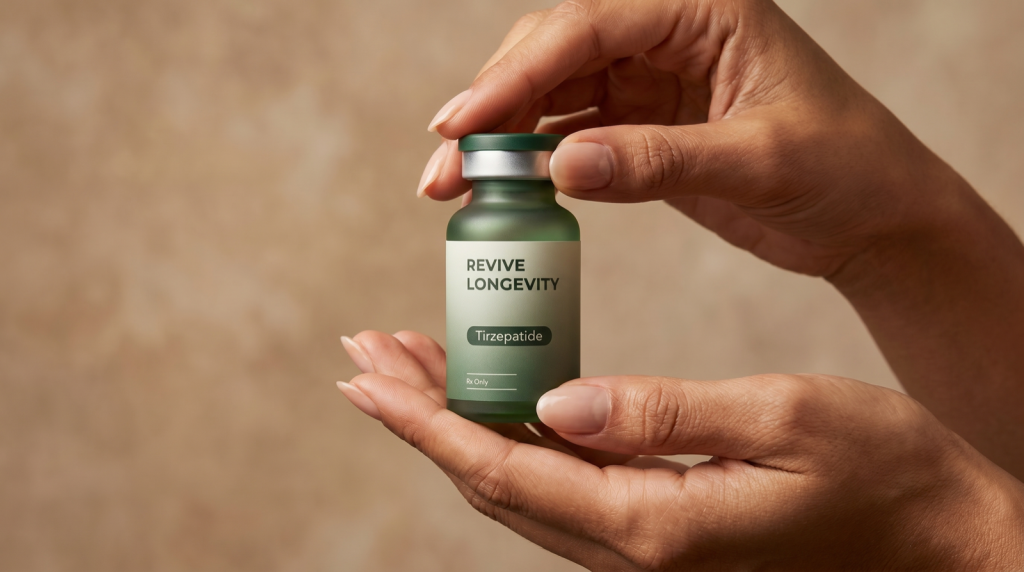
Is Revive’s tirzepatide the same as the branded products?
This is an important distinction. The injection-technique facts above all come from the FDA-approved branded labels: Zepbound (for weight management) and Mounjaro (for type 2 diabetes). Revive’s tirzepatide is a compounded medication, which is not FDA-approved. The FDA does not review compounded drugs for safety, effectiveness, or quality before they are marketed, and it has flagged concerns such as dosing errors and unapproved salt forms, as noted in its statement on unapproved GLP-1 drugs.
Access to compounded GLP-1s is also limited. The FDA determined the tirzepatide shortage resolved as of October 2024 (reconfirmed in December 2024) and declared the injectable semaglutide shortage resolved in February 2025, so mass compounding on shortage grounds is no longer permitted after defined wind-down periods, per the FDA’s policy clarification. Whether a compounded option is appropriate for you is a decision for a licensed provider.
Frequently asked questions
Can I inject tirzepatide in my arm myself?
Per the FDA-approved labels, the back of the upper arm is a site for when another person gives the injection, not a routine self-injection site, because it is difficult to reach yourself. The two self-injection sites the label describes are the abdomen and the thigh. Follow your product’s Instructions for Use.
Do I need to change my dose if I switch injection sites?
No. The Zepbound Clinical Pharmacology data show similar drug exposure across the abdomen, thigh, and upper arm (about 80% mean absolute bioavailability), which is why the label allows changing the site without a dose adjustment. Your dose is determined by your prescriber.
How far apart should my injection spots be?
The label instructs rotating the site with each dose; you can reuse the same body area but should pick a different spot. A practical habit is to move at least a finger-width or two from your last injection so you do not repeatedly hit the same point, which helps prevent fatty lumps (lipohypertrophy) that can make absorption inconsistent.
What time of day should I inject tirzepatide?
Tirzepatide is injected once weekly at any time of day, with or without meals, per the Mounjaro label. If you want to change your injection day, Lilly’s guidance says to keep at least 3 days (72 hours) between two doses. Ask your pharmacist if you are unsure about timing or a missed dose.
Is compounded tirzepatide FDA-approved?
No. Compounded tirzepatide is not FDA-approved, and the FDA does not review compounded drugs for safety, effectiveness, or quality before marketing. The FDA-approved tirzepatide products are Zepbound and Mounjaro. A licensed provider can help you understand the differences and what is appropriate for you.
Does it matter which device I use?
Yes. Tirzepatide can come as a single-dose pen, a KwikPen, or a vial-and-syringe, and the steps differ by device. Always read the specific Instructions for Use that came with your product, and ask your pharmacist to demonstrate if anything is unclear.
Talk to a licensed provider about tirzepatide
Wondering whether tirzepatide fits your goals? Start with an evaluation and let a licensed provider review your health history and answer your questions.
Compounded tirzepatide is not FDA-approved; the FDA has not evaluated it for safety, quality, or efficacy. This information is educational and not medical advice. Always follow the Instructions for Use and your prescriber’s and pharmacist’s guidance. Individual results vary.
U.S. Food and Drug Administration / Eli Lilly. ZEPBOUND (tirzepatide) prescribing information and Instructions for Use (Dosage and Administration 2.4; Clinical Pharmacology 12.3). DailyMed. https://dailymed.nlm.nih.gov/dailymed/drugInfo.cfm?setid=487cd7e7-434c-4925-99fa-aa80b1cc776b
U.S. Food and Drug Administration / Eli Lilly. MOUNJARO (tirzepatide) prescribing information (Dosage and Administration 2.1-2.2). DailyMed. https://dailymed.nlm.nih.gov/dailymed/drugInfo.cfm?setid=d2d7da5d-ad07-4228-955f-cf7e355c8cc0
Eli Lilly and Company. How to use Mounjaro (dosing day change; at least 72 hours between doses). https://mounjaro.lilly.com/how-to-use-mounjaro
Jastreboff AM, et al. Tirzepatide Once Weekly for the Treatment of Obesity (SURMOUNT-1). New England Journal of Medicine (2022). https://www.nejm.org/doi/full/10.1056/NEJMoa2206038
Eli Lilly and Company. Lilly’s SURMOUNT-1 Results Published in the New England Journal of Medicine (treatment-regimen and efficacy estimands). Investor news release (2022). https://investor.lilly.com/news-releases/news-release-details/lillys-surmount-1-results-published-new-england-journal-medicine
U.S. Food and Drug Administration. FDA’s Concerns with Unapproved GLP-1 Drugs Used for Weight Loss. https://www.fda.gov/drugs/postmarket-drug-safety-information-patients-and-providers/fdas-concerns-unapproved-glp-1-drugs-used-weight-loss
U.S. Food and Drug Administration. FDA Clarifies Policies for Compounders as National GLP-1 Supply Begins to Stabilize (tirzepatide shortage resolved Oct 2024, reconfirmed Dec 2024; semaglutide shortage resolved Feb 21, 2025). https://www.fda.gov/drugs/drug-alerts-and-statements/fda-clarifies-policies-compounders-national-glp-1-supply-begins-stabilize
Barola A, Tiwari P, Bhansali A, Grover S, Dayal D. Insulin-Related Lipohypertrophy: Lipogenic Action or Tissue Trauma? Frontiers in Endocrinology (2018). PMC. https://pmc.ncbi.nlm.nih.gov/articles/PMC6218430/
Which areas of your health are you looking to improve?
Select all that apply.
Just a few details so we can recommend the right next step.
We'll route you to the best fit and follow up with personalized guidance.

 Medically reviewed by Diana Medina, PA-C, board-certified Physician Associate · Last reviewed June 14, 2026