Medically reviewed by Diana Medina, PA-C, board-certified Physician Associate · Last reviewed September 9, 2026
Key takeaways
The semaglutide dosing chart differs by product: per its FDA label, Wegovy (chronic weight management) steps up 0.25 → 0.5 → 1 → 1.7 → 2.4 mg once weekly, while Ozempic (type 2 diabetes) steps 0.25 → 0.5 → 1 → 2 mg once weekly.
On both labels the 0.25 mg dose is an initiation/titration step, not a therapeutic or maintenance dose; the roughly 4-week steps exist to help minimize gastrointestinal side effects.
Dosing is provider-determined and must not be self-started or self-escalated; this article is educational and defers to the FDA prescribing information and your prescriber or pharmacist.
FDA-approved semaglutide (Wegovy, Ozempic) follows these labeled charts; compounded semaglutide is not FDA-approved and its dosing is not standardized.
A semaglutide dosing chart maps how a clinician gradually steps the dose up over several weeks, and it is not the same for every product. The two FDA-approved semaglutide injections, Wegovy (for chronic weight management) and Ozempic (for type 2 diabetes), each carry their own escalation schedule in their prescribing information. This page summarizes those labeled charts for education only. It is not personalized dosing or medical advice, and it does not tell anyone to start, change, stop, or self-escalate a dose — those decisions belong to a licensed prescriber.
What is the Wegovy semaglutide dosing chart?
According to the FDA prescribing information for Wegovy (Dosage and Administration, Table 1), the once-weekly subcutaneous dose is escalated in roughly 4-week steps. The label states the gradual schedule is intended to minimize gastrointestinal adverse reactions.
Time period
Wegovy dose (once weekly)
Step purpose
Weeks 1–4
0.25 mg
Initiation / titration (not a maintenance dose)
Weeks 5–8
0.5 mg
Escalation
Weeks 9–12
1 mg
Escalation
Weeks 13–16
1.7 mg
Escalation
Week 17 onward
2.4 mg
Recommended maintenance (1.7 mg is an alternative maintenance dose)
The label lists the recommended maintenance dosage as 2.4 mg once weekly, with 1.7 mg once weekly as an alternative maintenance option. It also notes that if a patient does not tolerate a dose during escalation, the prescriber may consider delaying escalation for 4 weeks; if 2.4 mg is not tolerated, the maintenance dosage may be reduced to 1.7 mg once weekly; and Wegovy should be discontinued if the patient cannot tolerate 1.7 mg. These are prescriber decisions, not steps to take on your own.
What is the Ozempic semaglutide dosing chart?
Ozempic is the type 2 diabetes formulation of semaglutide, and its escalation differs from Wegovy’s, especially at the top of the chart. Per the FDA prescribing information for Ozempic, treatment is initiated at 0.25 mg once weekly for 4 weeks. The label is explicit that the 0.25 mg dose is intended for treatment initiation and is not effective for glycemic control — in other words, it is a titration step, not a therapeutic dose.
Step
Ozempic dose (once weekly)
Notes (per FDA label)
Initiation (4 weeks)
0.25 mg
Initiation only; not effective for glycemic control
Next step
0.5 mg
Maintenance option
If more control needed
1 mg
After at least 4 weeks; maintenance option
If more control needed
2 mg
After at least 4 weeks; maximum recommended dosage
The Ozempic label lists maintenance dosages of 0.5 mg, 1 mg, or 2 mg once weekly, with each increase made after at least 4 weeks if additional glycemic control is needed, and a maximum recommended dosage of 2 mg once weekly. Note that Ozempic tops out at 2 mg, whereas Wegovy’s chart goes to 2.4 mg — the numbers are not interchangeable between the two products.
Per the FDA labels, semaglutide is stepped up gradually in roughly 4-week intervals; the pace is provider-determined.
Why does semaglutide start so low and escalate slowly?
Both labels build in a gradual, roughly 4-week step-up rather than starting at the target dose. The Wegovy prescribing information describes this slow escalation as a way to minimize gastrointestinal adverse reactions, which can include nausea and related GI symptoms when a GLP-1 medication is introduced. If a step is not tolerated, the Wegovy label tells the prescriber to consider holding at the current dose for an extra 4 weeks before escalating again. Tolerability and pacing vary widely from person to person, so the timing and any dose adjustments are determined by your provider, not by a fixed calendar.
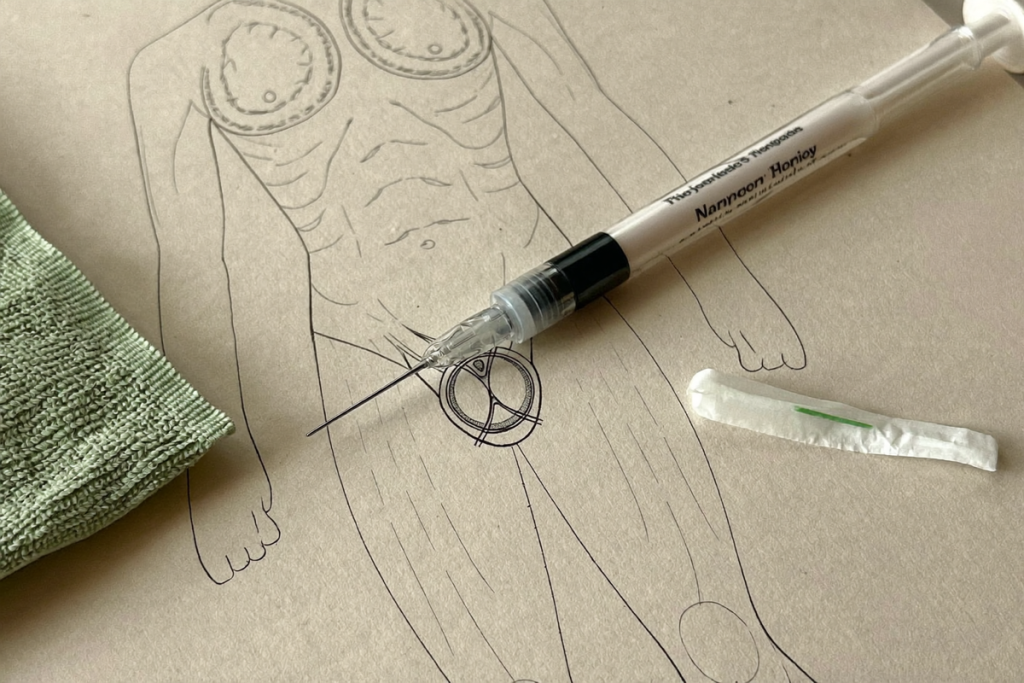
The FDA labels list abdomen, thigh, or upper arm as subcutaneous sites; rotating sites does not change the dose.
Where is semaglutide injected, and does the site change the dose?
According to the Wegovy prescribing information, semaglutide is injected subcutaneously in the abdomen, thigh, or upper arm, and the time of day and the injection site can be changed without dose adjustment. The Ozempic label gives the same three sites and advises using a different injection site each week when injecting in the same body region. In short, rotating sites does not change your dose. For a step-by-step educational walkthrough, see how to inject semaglutide and the companion guide on semaglutide injection sites — always following your product’s Instructions for Use.
What weight change did the semaglutide trials report?
In STEP 1 (Wilding et al., NEJM 2021), a 68-week trial of once-weekly semaglutide 2.4 mg in 1,961 adults with overweight or obesity but without type 2 diabetes, the mean change in body weight from baseline was about 14.9–15% with semaglutide versus −2.4% with placebo, and all participants received a reduced-calorie diet and increased physical activity. This is a trial average over more than a year alongside lifestyle intervention, not a guaranteed or typical personal outcome; individual results vary and dosing is provider-determined. For what a timeline can look like, see how long semaglutide takes to work.
As adjacent context with a different drug: in SURMOUNT-1 (Jastreboff et al., NEJM 2022), tirzepatide — the active ingredient in Zepbound and Mounjaro, which is not semaglutide — produced mean body-weight changes of about −15.0% (5 mg), −19.5% (10 mg), and −20.9% (15 mg) versus −3.1% with placebo over 72 weeks in adults without diabetes, also with lifestyle intervention. Those figures belong to tirzepatide and should never be read as a semaglutide result.
FDA-approved versus compounded semaglutide
Wegovy and Ozempic (semaglutide) are FDA-approved, and the dosing charts above come directly from their FDA labels. By contrast, compounded semaglutide is not FDA-approved; the FDA has not evaluated it for safety, effectiveness, or quality, and its formulation and dosing are not standardized. The FDA issued a declaratory order on February 21, 2025 determining that the semaglutide shortage was resolved, and enforcement-discretion windows for compounders subsequently closed in 2025, so large-scale compounding under the shortage justification is no longer permitted. (Separately, the FDA removed tirzepatide from its shortage list on October 2, 2024, re-confirmed by declaratory order on December 19, 2024.) Whichever product a prescriber considers, the dose, schedule, and any adjustments are individualized and follow the relevant FDA labeling and Instructions for Use.
Frequently asked questions
Is the 0.25 mg dose a maintenance dose?
No. On both the Wegovy and Ozempic FDA labels, 0.25 mg once weekly is an initiation or titration step. The Ozempic label states plainly that 0.25 mg is intended for treatment initiation and is not effective for glycemic control. Maintenance dosing is higher and is determined by the prescriber.
How long does each step in the semaglutide escalation last?
Per the FDA labels, the steps are spaced roughly 4 weeks apart. The Wegovy label adds that if a dose is not tolerated, the prescriber may consider delaying escalation for another 4 weeks. The exact pace is provider-determined and individualized.
Why is Wegovy’s top dose 2.4 mg but Ozempic’s is 2 mg?
They are different FDA-approved products with separate labels. Wegovy (chronic weight management) escalates to a recommended maintenance dose of 2.4 mg once weekly, while Ozempic (type 2 diabetes) has a maximum recommended dosage of 2 mg once weekly. The numbers should not be swapped between products.
Does changing the injection site change my dose?
No. The Wegovy label states the injection site can be changed without dose adjustment, and Ozempic uses the same three subcutaneous sites — abdomen, thigh, or upper arm — with weekly rotation. Site rotation does not alter the dose. Follow your product’s Instructions for Use and your prescriber’s guidance.
Will I lose about 15% of my body weight on semaglutide?
Not necessarily. The roughly 14.9–15% figure is a mean average from the 68-week STEP 1 trial of semaglutide 2.4 mg, in which every participant also followed a reduced-calorie diet and increased physical activity. It is not a guarantee; individual results vary, and any treatment plan is provider-determined.
Is compounded semaglutide dosed the same as Wegovy or Ozempic?
Compounded semaglutide is not FDA-approved, and the FDA has not evaluated it for safety, effectiveness, or quality. Its dosing is not standardized, so it cannot be assumed to match the FDA-labeled charts. Any questions about a specific product should go to your prescriber and pharmacist.
See how Revive approaches GLP-1 care
If you’re exploring whether a GLP-1 medication is appropriate for you, Revive Longevity connects you with a licensed provider who reviews your history and determines any treatment plan individually. No outcome is promised.
Educational information only, not medical advice. Prescription treatments require a consultation with a licensed provider, who determines whether treatment is appropriate. Some medications may be compounded; compounded medications are not FDA-approved, and the FDA has not evaluated them for safety, quality, or efficacy. Individual results vary.
U.S. Food and Drug Administration / Novo Nordisk. Wegovy (semaglutide) injection prescribing information (Dosage and Administration, Table 1). DailyMed. https://dailymed.nlm.nih.gov/dailymed/drugInfo.cfm?setid=f5e548d0-cc79-4c34-a3f5-e20a5b8b6564
U.S. Food and Drug Administration / Novo Nordisk. Ozempic (semaglutide) injection prescribing information (Dosage and Administration). DailyMed. https://dailymed.nlm.nih.gov/dailymed/drugInfo.cfm?setid=adec4fd2-6858-4c99-91d4-531f5f2a2d79
Wilding JPH, et al. Once-Weekly Semaglutide in Adults with Overweight or Obesity (STEP 1). New England Journal of Medicine (2021). https://www.nejm.org/doi/full/10.1056/NEJMoa2032183
Jastreboff AM, et al. Tirzepatide Once Weekly for the Treatment of Obesity (SURMOUNT-1). New England Journal of Medicine (2022). https://pubmed.ncbi.nlm.nih.gov/35658024/
U.S. Food and Drug Administration. FDA’s Concerns with Unapproved GLP-1 Drugs Used for Weight Loss (2025). https://www.fda.gov/drugs/drug-alerts-and-statements/fdas-concerns-unapproved-glp-1-drugs-used-weight-loss
Foley & Lardner LLP. FDA Removes Semaglutide from Drug Shortage List (Declaratory Order, Feb 21, 2025). Foley Insights (2025). https://www.foley.com/insights/publications/2025/02/glp-1-drugs-fda-removes-semaglutide-from-drug-shortage-list/
U.S. Food and Drug Administration. Declaratory Order: Resolution of Shortages of Tirzepatide Injection Products (Dec 19, 2024). https://www.fda.gov/media/184606/download
Which areas of your health are you looking to improve?
Select all that apply.
Just a few details so we can recommend the right next step.
We'll route you to the best fit and follow up with personalized guidance.


 Medically reviewed by Diana Medina, PA-C, board-certified Physician Associate · Last reviewed September 9, 2026