How to Inject Semaglutide: A Step-by-Step Overview
June 13, 2026 · Weight Loss
Medically reviewed by Diana Medina, PA-C, board-certified Physician Associate · Last reviewed September 9, 2026
Key takeaways
The FDA-approved semaglutide products (Wegovy and Ozempic) are given as a once-weekly subcutaneous injection in the abdomen, thigh, or upper arm, and the site can be changed without a dosage modification.
This is general education, not medical advice. Always follow your specific product’s Instructions for Use (IFU) and your prescriber or pharmacist; never start, change, or self-manage a dose on your own.
FDA-approved semaglutide comes as a prefilled pen with a built-in mechanism; compounded vial-and-syringe products are a different, non-FDA-approved presentation tied to serious dosing errors (up to 5 to 20 times the intended dose).
Used needles go straight into an FDA-cleared sharps container, never loose in the household trash, and are then disposed of per state and local rules.
Learning how to inject semaglutide at home starts with one principle: the medication is designed as a once-weekly subcutaneous injection, and the exact technique belongs to your specific product’s Instructions for Use (IFU) and your prescriber or pharmacist, not to a generic article. According to the FDA-approved labels for Wegovy (semaglutide) and Ozempic (semaglutide), the medicine is injected under the skin of the abdomen, thigh, or upper arm. This overview walks through the general mechanics so the steps feel less unfamiliar. It is not personalized medical advice, and it will not tell you what dose to take.
This is general education, not medical advice. For anything specific to you, contact your prescriber or pharmacist.
Where is semaglutide injected, and how often?
Both FDA-approved semaglutide products are injected subcutaneously (into the fatty layer just under the skin) once weekly. The three label-permitted sites are the abdomen, thigh, or upper arm. The Wegovy label states that “the time of day and the injection site can be changed without the need for a dosage modification” — so you do not need to change anything about your prescribed dose simply because you switch from, say, your abdomen to your thigh one week.
“Rotating sites” is grounded in the Ozempic label, which instructs patients to “use a different injection site each week when injecting in the same body region.” For a deeper look at site selection and rotation, see our companion overview on semaglutide injection sites. Picking a consistent weekly day helps with adherence; the Ozempic label notes the dosing day “can be changed if necessary as long as the time between two doses is at least 2 days (>48 hours).”
FDA-approved semaglutide is injected subcutaneously in the abdomen, thigh, or upper arm, once weekly.
What is the difference between a semaglutide pen and a vial?
This distinction is the most important safety point in the entire process. Wegovy and Ozempic, both made by Novo Nordisk, are the FDA-approved semaglutide products, supplied as prefilled pens with a built-in dosing mechanism and reviewed by the FDA for safety, effectiveness, and quality. By contrast, compounded semaglutide is not FDA-approved, and the FDA does not review it for safety, effectiveness, or quality before it is marketed.
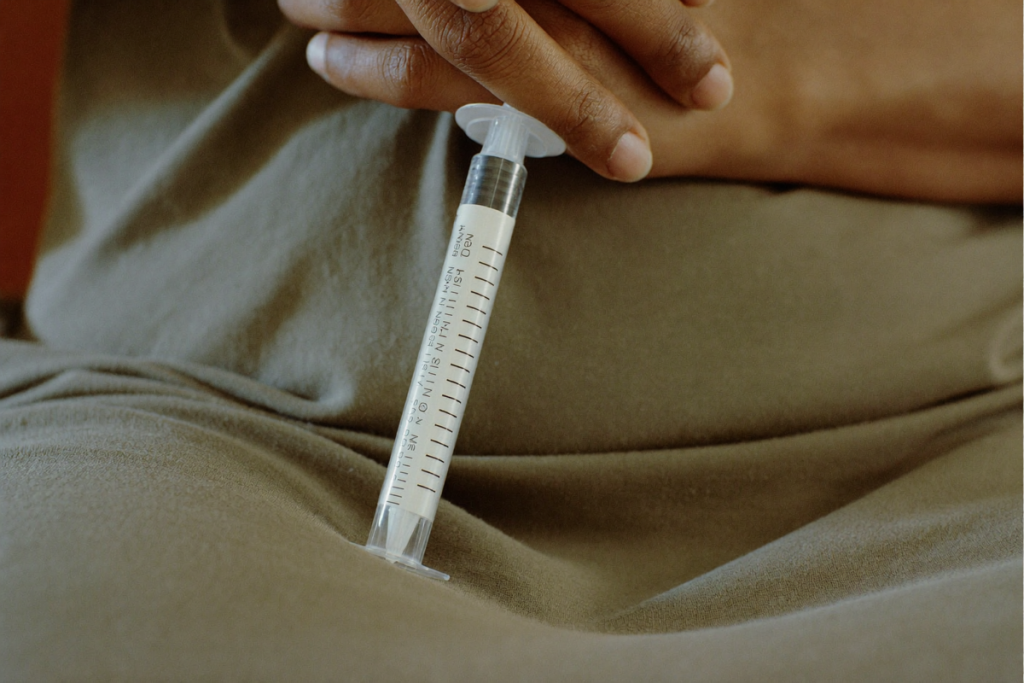
The vial-and-syringe presentation carries a documented hazard. In a July 2024 alert, the FDA reported dosing errors — some requiring hospitalization — in which patients gave themselves as much as 5 to 20 times the intended dose. The errors were linked to people new to self-injection, unfamiliar with withdrawing medication from a vial into a syringe, and confused between units of measurement. This is precisely why a generic article cannot teach vial-and-syringe measuring: that step must be set and demonstrated by your prescriber or pharmacist using your specific product’s IFU.
Feature
FDA-approved pen (Wegovy, Ozempic)
Compounded vial + syringe
FDA status
FDA-approved; reviewed for safety, effectiveness, quality
Not FDA-approved; not FDA-reviewed for safety, quality, or efficacy
Dose delivery
Built-in pen mechanism
User measures and withdraws from a vial
Documented risk
Standardized delivery
FDA: dosing errors up to 5 to 20x intended dose
Source of technique
Product IFU + pharmacist
Product IFU + pharmacist (mandatory)
Revive’s tirzepatide product is a compounded medication — compounded; not FDA-approved; not evaluated by the FDA for safety, quality, or efficacy. If you are comparing molecules, our tirzepatide vs. semaglutide overview explains the differences.
What does a general step-by-step look like?
The following is a general orientation only. Exact technique — priming, needle angle, how long to hold the pen against the skin — varies by device, so follow your pen’s IFU and the instruction your pharmacist gives you.
Wash your hands and gather supplies on a clean surface: your prescribed pen, an alcohol swab, and an FDA-cleared sharps container.
Inspect the medication as the IFU directs; do not use it if it looks discolored or has visible particles.
Choose and clean a site — abdomen, thigh, or upper arm — and rotate from the previous week’s spot.
Attach a new needle and prime exactly as your specific pen’s IFU instructs.
Inject and hold per the IFU, then dispose of the needle immediately in your sharps container.
Mild injection-site reactions and gastrointestinal effects such as nausea can occur, especially early on. Discuss anything that concerns you with your provider, and seek medical care for signs of a severe allergic reaction or a suspected overdose.
Why do prescribers start low and increase slowly?
You may have seen the dose “ladders” online. Presented here as label background only — not a schedule for you to follow on your own — these escalation steps exist mainly to improve gastrointestinal tolerability. A prescriber sets and adjusts every dose.
Product
Escalation per FDA label
Maximum
Wegovy (semaglutide)
0.25 → 0.5 → 1.0 → 1.7 → 2.4 mg once weekly, increasing at ~4-week intervals (2.4 mg reached at week 17)
2.4 mg once weekly (maintenance; 1.7 mg is an allowed alternative for those who cannot tolerate 2.4 mg)
Ozempic (semaglutide)
0.25 mg for 4 weeks (initiation; “not effective for glycemic control”) → 0.5 → 1 → 2 mg once weekly
2 mg once weekly
The Wegovy ladder is drawn from the FDA Wegovy label; the Ozempic ladder, including the note that 0.25 mg “is not effective for glycemic control,” is from the Ozempic label. Note the maxima differ: Wegovy tops out at 2.4 mg, Ozempic at 2 mg — they are not interchangeable. For a fuller walkthrough of the schedule, see our semaglutide dosing chart.
What can I realistically expect from semaglutide?
Any number you encounter is a trial average in a specific population, not a promise. In STEP 1 (Wilding et al., NEJM 2021), once-weekly semaglutide 2.4 mg produced a mean body-weight change of -14.9% versus -2.4% with placebo over 68 weeks, in adults with overweight or obesity without diabetes. Crucially, both groups received lifestyle intervention — a reduced-calorie diet and increased physical activity. Individual results vary, and weight outcomes are provider-determined.
For context only: tirzepatide is a different drug, and figures from the SURMOUNT-1 trial (-15.0%, -19.5%, and -20.9% at 5, 10, and 15 mg over 72 weeks) belong to tirzepatide and must never be attributed to semaglutide. Timelines also vary; our overview of how long semaglutide takes to work covers what the evidence does and does not show.
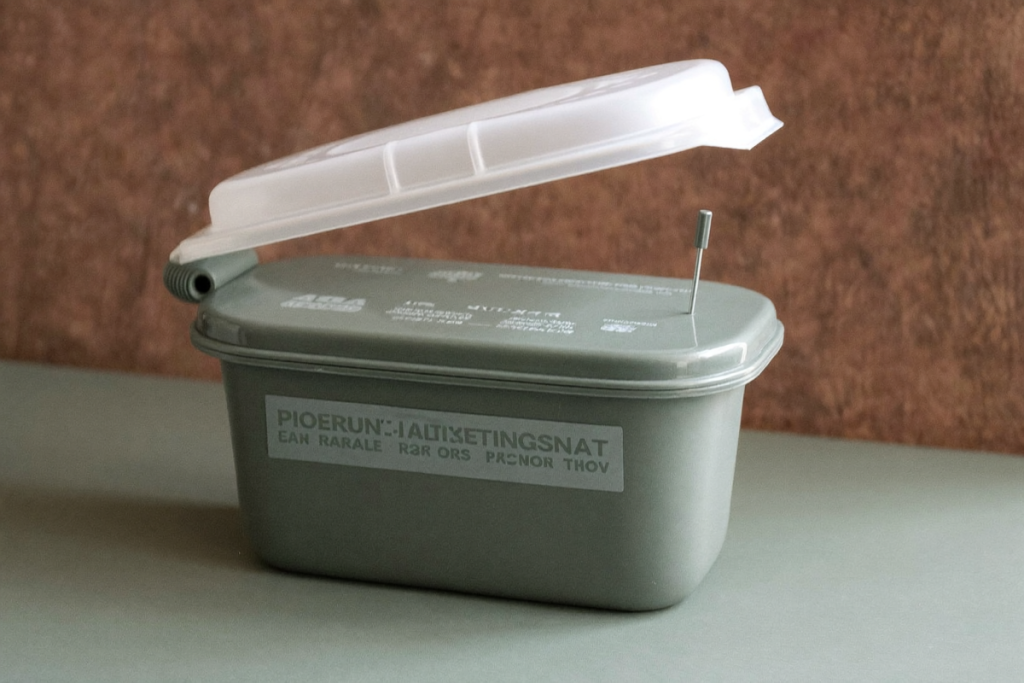
The FDA recommends placing used sharps immediately in an FDA-cleared container, then disposing per local rules.
How should I dispose of used needles?
The FDA recommends a two-step process. First, immediately place used needles and syringes in an FDA-cleared sharps disposal container — or, if one is not available, a sturdy, puncture-resistant household container. Second, dispose of the full container following your state and local guidelines, such as drop-off collection sites or mail-back programs. Never throw loose needles in the household trash, and never recap a needle unsafely.
Frequently asked questions
Where on the body do you inject semaglutide?
The FDA-approved labels permit subcutaneous injection in the abdomen, thigh, or upper arm. The site can be changed without a dosage modification, and the Ozempic label advises using a different site each week within the same body region. Follow your product’s IFU.
How often is semaglutide injected?
Once weekly, per the FDA-approved labels for Wegovy and Ozempic. The dosing day can be changed if necessary, as long as at least 2 days (>48 hours) separate two doses, according to the Ozempic label.
Is a pen safer than a vial and syringe?
FDA-approved pens have a built-in dosing mechanism and are reviewed by the FDA. The FDA has documented dosing errors of up to 5 to 20 times the intended dose with compounded vial-and-syringe products, often among people new to self-injection. Any vial measuring must be taught by your prescriber or pharmacist using the product IFU.
Can I set or change my own dose using the label ladders?
No. The escalation ladders in this article are label background that explains why prescribers start low and go slow for tolerability. Starting, changing, skipping, or self-managing a dose is for your prescriber to direct — not for you to do on your own.
Are compounded GLP-1s still freely available?
No. The FDA removed tirzepatide from the shortage list in October 2024 (declaratory order December 19, 2024), and the semaglutide shortage was declared resolved on February 21, 2025. Compounding wind-down ran to April 22, 2025 (503A) and May 22, 2025 (503B), after which large-scale compounding is no longer permitted.
How do I dispose of the needle after injecting?
Place it immediately in an FDA-cleared sharps container (or a sturdy, puncture-resistant container), never in loose household trash, then dispose of the full container per your state and local rules, per FDA sharps guidance.
Talk with a licensed provider before you inject anything
This article is general education, not medical advice. Revive connects you with a licensed provider who can review your history and determine whether a weight-management program is appropriate for you.
Educational information only; not medical advice. Prescription treatments require a consultation with a licensed provider, who determines whether treatment is appropriate — no specific outcome or weight loss is promised, and individual results vary. Revive’s compounded medications are compounded; not FDA-approved; and not evaluated by the FDA for safety, quality, or efficacy. Always follow your product’s Instructions for Use and your prescriber or pharmacist.
U.S. Food & Drug Administration. Wegovy (semaglutide) Prescribing Information / label (2025). https://www.accessdata.fda.gov/drugsatfda_docs/label/2025/215256s026lbl.pdf
DailyMed (U.S. National Library of Medicine). Ozempic (semaglutide) label. https://dailymed.nlm.nih.gov/dailymed/drugInfo.cfm?setid=adec4fd2-6858-4c99-91d4-531f5f2a2d79
U.S. Food & Drug Administration. FDA’s Concerns with Unapproved GLP-1 Drugs Used for Weight Loss. https://www.fda.gov/drugs/drug-alerts-and-statements/fdas-concerns-unapproved-glp-1-drugs-used-weight-loss
U.S. Food & Drug Administration. FDA Alerts Health Care Providers, Compounders and Patients of Dosing Errors Associated with Compounded Injectable Semaglutide Products (July 2024). https://www.fda.gov/drugs/human-drug-compounding/fda-alerts-health-care-providers-compounders-and-patients-dosing-errors-associated-compounded
U.S. Food & Drug Administration. FDA clarifies policies for compounders as national GLP-1 supply begins to stabilize. https://www.fda.gov/drugs/drug-alerts-and-statements/fda-clarifies-policies-compounders-national-glp-1-supply-begins-stabilize
U.S. Food & Drug Administration. Best Way to Get Rid of Used Needles and Other Sharps. https://www.fda.gov/medical-devices/safely-using-sharps-needles-and-syringes-home-work-and-travel/best-way-get-rid-used-needles-and-other-sharps
Wilding JPH, et al. Once-Weekly Semaglutide in Adults with Overweight or Obesity (STEP 1). New England Journal of Medicine (2021). https://www.nejm.org/doi/full/10.1056/NEJMoa2032183
Jastreboff AM, et al. Tirzepatide Once Weekly for the Treatment of Obesity (SURMOUNT-1). New England Journal of Medicine (2022). https://www.nejm.org/doi/full/10.1056/NEJMoa2206038
Which areas of your health are you looking to improve?
Select all that apply.
Just a few details so we can recommend the right next step.
We'll route you to the best fit and follow up with personalized guidance.


 Medically reviewed by Diana Medina, PA-C, board-certified Physician Associate · Last reviewed September 9, 2026