
Foods That May Support Healthy Testosterone
 Medically reviewed by Diana Medina, PA-C, board-certified Physician Associate · Last reviewed June 14, 2026
Key takeaways
- There is no proven “testosterone diet.” The strongest evidence is that correcting a documented nutrient deficiency (such as zinc) may help, while supplementing men who already have adequate intake generally does not.
- Vitamin D supplementation did not meaningfully raise testosterone in randomized trials, even in vitamin D-insufficient men, so popular “vitamin D foods boost testosterone” claims are not well supported.
- The larger, better-supported levers are a healthy weight, adequate sleep, and regular exercise, not any single food.
- Foods and supplements are supportive lifestyle measures, not a treatment for diagnosed low testosterone, which is a medical diagnosis managed under a prescription with monitoring.
If you are searching for foods to boost testosterone, the honest, evidence-based answer is more nuanced than most headlines suggest: no specific food has been shown to reliably raise testosterone in men who are already well nourished. What the research does support is narrower and more practical. Correcting a true nutrient deficiency may help, an overall healthy eating pattern is better than chasing single “superfoods,” and broader habits like sleep, weight, and exercise tend to matter more than your grocery list. This article walks through what the studies actually show, where the popular claims overreach, and when symptoms warrant talking to a licensed provider rather than self-treating with diet.
Can any food actually raise testosterone?
For most men eating a reasonable diet, the answer appears to be no, not in a meaningful, lasting way. The clearest exception is reversing a genuine deficiency. In a small 1996 study by Prasad and colleagues, marginally zinc-deficient elderly men (mean age 64) who took oral zinc for 3 to 6 months saw serum testosterone rise from 8.3 to 16.0 nmol/L (Prasad et al., 1996). The same study experimentally restricted dietary zinc in young men, and their testosterone fell from 39.9 to 10.6 nmol/L over roughly 20 weeks.
That pattern, deficiency lowers testosterone and repletion can restore it, is very different from saying extra zinc raises testosterone in men who already get enough. It does not. When 40 mg/day of zinc was added to hormone therapy in men with diagnosed hypogonadotropic hypogonadism, the added benefit was described as “very subtle,” with no statistically significant difference in serum testosterone versus controls over 18 months (RCT, 2017).
Which nutrients are linked to testosterone, and how strong is the evidence?
A few micronutrients come up repeatedly. Here is what the better studies show, with their populations stated, because the population matters.
| Nutrient / approach | What the evidence shows | Population studied |
|---|---|---|
| Zinc (correcting deficiency) | Repletion raised T from 8.3 to 16.0 nmol/L; restriction lowered it. Helps only when deficient. | Marginally deficient/restricted men, Prasad 1996 |
| Zinc (already adequate) | “Very subtle,” non-significant added effect when intake is sufficient. | Men with hypogonadotropic hypogonadism on hormone therapy |
| Vitamin D | No significant effect on total testosterone (median change 0.5 nmol/L; P=0.497). | 98 healthy men, baseline 25(OH)D <75 nmol/L (vitamin D-insufficient), Graz RCT, JCEM 2017 |
| Magnesium | Modest increase, larger in men who exercised than sedentary men. | Small 4-week study, athletes vs sedentary men, Cinar 2011 |
Vitamin D is the clearest cautionary tale. In the Graz Vitamin D and Testosterone RCT, 98 healthy middle-aged men took 20,000 IU/week of vitamin D3 or placebo for 12 weeks, and there was no significant effect on total testosterone (Lerchbaum et al., JCEM 2017). A separate RCT in men with low testosterone reached the same null conclusion (Lerchbaum et al., 2018). Correcting a vitamin D deficiency is worthwhile for general health, but treating it as a testosterone booster is not supported.
Magnesium showed a modest signal: in a small 4-week study, magnesium supplementation modestly increased free and total testosterone, with larger increases in men who exercised than in sedentary men (Cinar et al., 2011). Even here, the effect was small and tied to physical activity rather than the mineral alone.
Is there a best diet to raise testosterone?
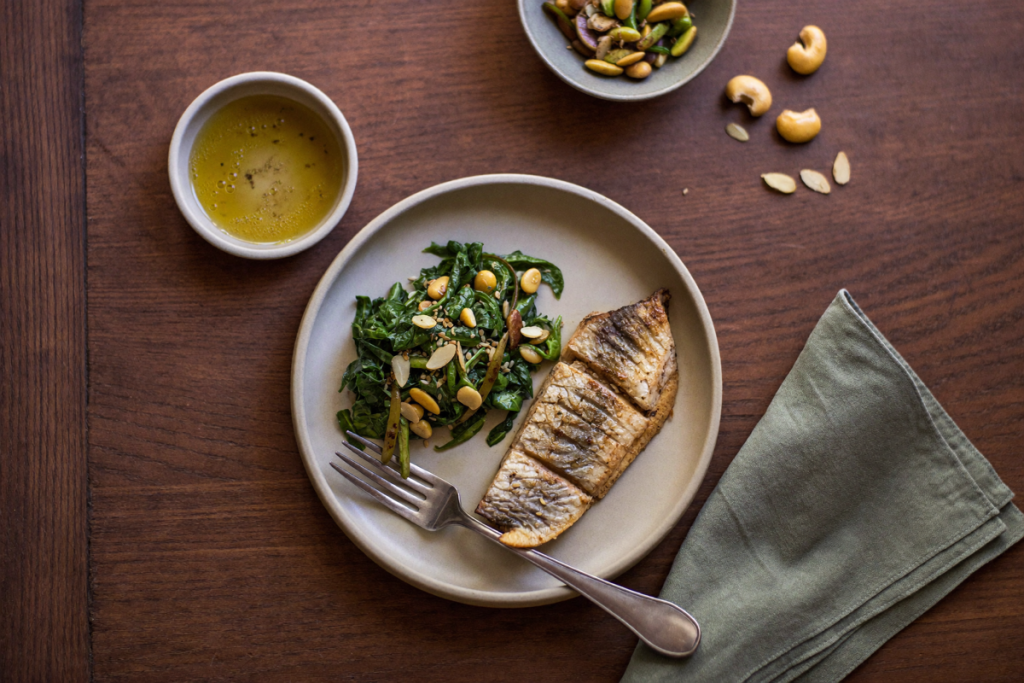
This is where popular advice gets the direction wrong. A 2021 systematic review and meta-analysis of 6 controlled intervention studies (206 men) found that low-fat diets modestly lowered total testosterone (standardized mean difference -0.38; 95% CI -0.75 to -0.01; P=0.04) and free testosterone (Whittaker & Wu, 2021). So aggressively cutting healthy fats may work against you, though the effect is modest.
And a “healthy” eating pattern is not automatically a testosterone-raising one. In a US NHANES analysis, mean total testosterone was actually slightly lower among men adhering to a Mediterranean diet (412.9 ng/dL) than among men on non-restrictive diets (443.5 ng/dL) (Fantus et al., 2020). That study is observational and cannot prove cause and effect, but it is a useful reminder: there is no validated “testosterone diet.” The practical takeaway is to eat a balanced diet that includes adequate (not minimal) healthy fats and supports a healthy weight, rather than hunting for individual T-boosting foods.
What lifestyle factors matter more than food?
If your goal is to support your own hormonal health, three levers have clearer evidence than any food.
Sleep. In a controlled study of 10 healthy young men (mean age 24), one week of sleep restricted to about 5 hours per night reduced daytime total testosterone by roughly 10 to 15% (Leproult & Van Cauter, JAMA 2011). For context, normal aging lowers testosterone only gradually over time. A week of short sleep can do more, and faster, than most diet tweaks.
Weight. In men with obesity, weight loss is associated with higher testosterone, thought to work through reduced aromatase activity, less inflammation, and better insulin sensitivity (Cureus review, 2024). Both moderate and larger reductions in BMI have been associated with notable increases in serum testosterone, but the size of any individual response varies and is not guaranteed.
Exercise. Resistance exercise produces acute, short-lived testosterone increases, but chronic training has inconsistent or negligible effects on resting (baseline) testosterone (Riachy et al., 2020). Exercise is genuinely worth doing for many reasons, but the resting-testosterone payoff is not guaranteed.
Which foods are good sources of testosterone-relevant nutrients?
If you want to make sure you are not deficient, food is a reasonable place to start. The NIH Office of Dietary Supplements lists the RDA for zinc as 11 mg/day for adult men and names oysters (exceptionally rich), red meat, poultry, and other seafood as good sources (NIH ODS Zinc Fact Sheet). Magnesium is found in nuts, seeds, legumes, and leafy greens; vitamin D in fatty fish, eggs, and fortified foods. Including these foods helps you meet basic needs, but, per the studies above, meeting your needs is the goal, not exceeding them in hopes of a testosterone boost.
When are foods not enough, and what does diagnosing low testosterone involve?
Symptoms often attributed to “low T,” such as low libido, fatigue, low mood, and reduced strength, overlap with many other conditions, including poor sleep, thyroid problems, and depression. That is exactly why diet and supplements are not a substitute for evaluation. Foods and supplements are supportive lifestyle measures; they are not a treatment for diagnosed hypogonadism.
Diagnosing low testosterone is a clinical process. The American Urological Association recommends diagnosing testosterone deficiency using total testosterone consistently below 300 ng/dL on at least two early-morning measurements, together with symptoms or signs (AUA Guideline, 2018). The Endocrine Society similarly recommends confirming unequivocally low testosterone on two separate fasting early-morning measurements before diagnosing hypogonadism (Bhasin et al., JCEM 2018). No food can replace that workup. If you are weighing options, our overview of signs you may need hormone therapy and the comparison of enclomiphene vs. TRT may help frame a conversation with a provider.
How does testosterone therapy differ from food and supplements?
Testosterone therapy (TRT) is a medical treatment, not a lifestyle one. Testosterone is a Schedule III controlled substance under the Controlled Substances Act, so it requires a valid prescription (21 CFR 1308.13). It also requires a formal diagnosis and ongoing monitoring of hemoglobin/hematocrit, PSA, and blood pressure. In February 2025, the FDA announced class-wide labeling changes that added a blood-pressure warning across testosterone products, removed the previous boxed cardiovascular warning after the TRAVERSE trial, and retained a Limitation of Use noting these products are approved for low testosterone due to an associated medical condition, not age-related decline alone (FDA, Feb 2025). For non-alarmist context, the TRAVERSE trial found testosterone non-inferior to placebo for major adverse cardiac events (7.0% vs 7.3%; HR 0.96), though all participants were hypogonadal men at high cardiovascular risk (TRAVERSE summary). If you want the practical details, see our TRT dosage guide and a plain-language explainer on whether testosterone is a controlled substance.
Frequently asked questions
Do foods really boost testosterone?
For men who are already well nourished, no food has been shown to reliably raise testosterone. The clearest exception is correcting a documented deficiency: in marginally zinc-deficient men, zinc repletion raised testosterone, but adding zinc to men with adequate intake produced no significant effect. Treat a balanced diet as a way to avoid deficiency, not as a testosterone treatment.
Does vitamin D increase testosterone?
The evidence is weak. In the Graz randomized controlled trial, 98 healthy men taking 20,000 IU/week of vitamin D3 for 12 weeks showed no significant change in total testosterone, and a separate trial in men with low testosterone also found no meaningful effect. Correcting a vitamin D deficiency is worthwhile for general health, but it should not be expected to raise testosterone.
What is the best diet to raise testosterone?
There is no validated “testosterone diet.” A 2021 meta-analysis found that low-fat diets modestly lowered testosterone, and a US NHANES analysis found mean testosterone was slightly lower among Mediterranean-diet adherents than men on non-restrictive diets. Overall diet quality, a healthy weight, sleep, and exercise matter more than any single eating pattern or food.
What lowers testosterone the most?
Among modifiable factors, short sleep stands out: one week of about 5 hours of sleep per night reduced daytime testosterone by roughly 10 to 15% in healthy young men, far more than the small, gradual decline seen with normal aging. Excess weight and a true nutrient deficiency can also lower testosterone. These effects vary between individuals.
Can food fix clinically low testosterone?
No. Diagnosed low testosterone (hypogonadism) is a medical condition, defined by symptoms plus total testosterone below 300 ng/dL on two early-morning tests per AUA guidance. It is managed with prescription therapy and monitoring, not with food or supplements. If you have symptoms like low libido, fatigue, or reduced strength, see a licensed provider for evaluation rather than self-treating, since these symptoms overlap many conditions.
Is testosterone therapy safe?
Testosterone therapy is a prescription-only controlled substance that requires a diagnosis and ongoing monitoring of blood counts, PSA, and blood pressure. In 2025 the FDA added a class-wide blood-pressure warning and removed the prior boxed cardiovascular warning following the TRAVERSE trial. Safety and suitability are individual and must be determined by a licensed provider; individual results vary.
Wondering if your symptoms point to low testosterone?
Diet and lifestyle can support overall health, but diagnosing low testosterone takes a clinical evaluation. Connect with a licensed Revive provider to discuss your symptoms, lab testing, and whether treatment may be appropriate for you.
Testosterone is a prescription-only, DEA Schedule III controlled substance that requires a diagnosis and ongoing monitoring (hemoglobin/hematocrit, PSA, blood pressure). If a prescribed plan includes any compounded formulation, note that compounded products are not FDA-approved and the FDA has not evaluated them for safety, quality, or efficacy. Educational information only, not medical advice. Individual results vary.
Sources
- Prasad AS, et al. Zinc status and serum testosterone levels of healthy adults. Nutrition (1996). https://www.sciencedirect.com/science/article/abs/pii/S089990079680058X
- Liu YL, et al. Effect of zinc supplementation on sequential gonadotropin therapy in men with hypogonadotropic hypogonadism (RCT). PMC (2017). https://pmc.ncbi.nlm.nih.gov/articles/PMC5427781
- Lerchbaum E, et al. Vitamin D and Testosterone in Healthy Men: A Randomized Controlled Trial. J Clin Endocrinol Metab (2017). https://academic.oup.com/jcem/article/102/11/4292/4096785
- Lerchbaum E, et al. Effects of vitamin D supplementation on androgens in men with low testosterone levels (RCT). European Journal of Nutrition (2018). https://www.ncbi.nlm.nih.gov/pmc/articles/PMC6842386/
- Cinar V, et al. Effects of magnesium supplementation on testosterone levels. Biol Trace Elem Res (2011). https://link.springer.com/article/10.1007/s12011-010-8676-3
- Whittaker J, Wu K. Low-fat diets and testosterone in men: systematic review and meta-analysis. J Steroid Biochem Mol Biol (2021). https://pubmed.ncbi.nlm.nih.gov/33741447/
- Fantus RJ, et al. The Association Between Popular Diets and Serum Testosterone Among Men in the US (NHANES). J Urol (2020). https://pubmed.ncbi.nlm.nih.gov/31393814/
- Leproult R, Van Cauter E. Effect of 1 Week of Sleep Restriction on Testosterone Levels in Young Healthy Men. JAMA (2011). https://pmc.ncbi.nlm.nih.gov/articles/PMC4445839/
- Impact of Weight Loss on Testosterone Levels: A Review of BMI and Testosterone. Cureus (2024). https://www.ncbi.nlm.nih.gov/pmc/articles/PMC11745839/
- Riachy R, et al. Various Factors May Modulate the Effect of Exercise on Testosterone Levels in Men. PMC (2020). https://pmc.ncbi.nlm.nih.gov/articles/PMC7739287/
- American Urological Association. Evaluation and Management of Testosterone Deficiency Guideline. J Urol (2018). https://www.auajournals.org/doi/10.1016/j.juro.2018.03.115
- Bhasin S, et al. Testosterone Therapy in Men With Hypogonadism: Endocrine Society Clinical Practice Guideline. J Clin Endocrinol Metab (2018). https://academic.oup.com/jcem/article/103/5/1715/4939465
- U.S. DEA / Controlled Substances Act. 21 CFR 1308.13, Schedule III. eCFR. https://www.ecfr.gov/current/title-21/chapter-II/part-1308/subject-group-ECFRf62f8e189108c4d/section-1308.13
- U.S. FDA. FDA Issues Class-Wide Labeling Changes for Testosterone Products (Feb 2025). https://www.fda.gov/drugs/drug-safety-and-availability/fda-issues-class-wide-labeling-changes-testosterone-products
- Pharmacy Times. FDA Issues New Labeling Changes Clarifying Safety of Testosterone Products (TRAVERSE summary). https://www.pharmacytimes.com/view/fda-issues-new-labeling-changes-clarifying-safety-of-testosterone-products-following-clinical-trials
- NIH Office of Dietary Supplements. Zinc Fact Sheet for Health Professionals. https://ods.od.nih.gov/factsheets/Zinc-HealthProfessional/